The average American wastes about a week annually sitting in traffic jams, but Nissan may have found a solution. The automaker's Silicon Valley research team has developed Cooperative Congestion Management (CCM), an innovative system that uses vehicle-to-vehicle communication to smooth traffic flow and reduce the stop-and-go patterns that plague modern highways.
How It Works
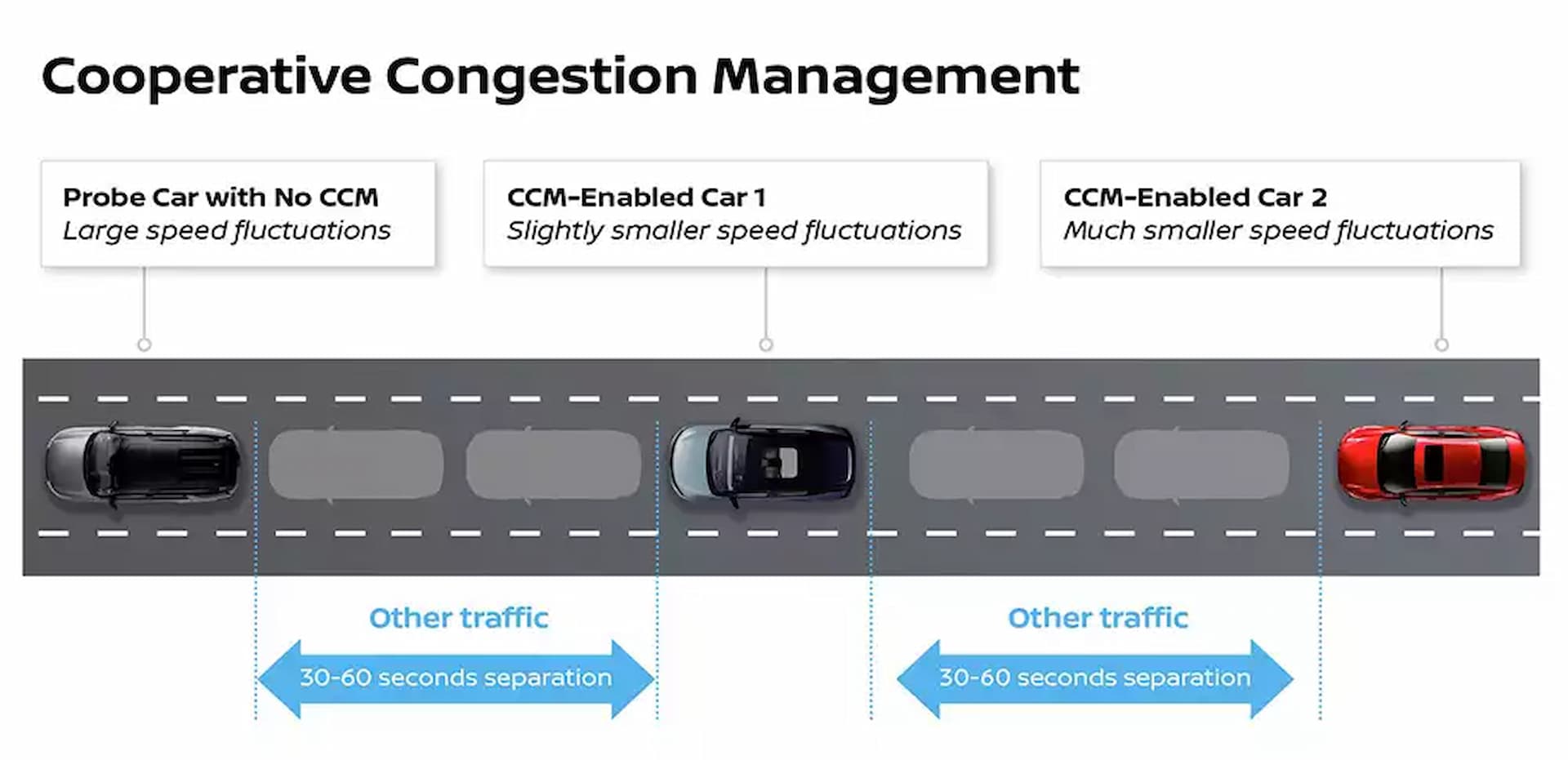
CCM addresses a fundamental flaw in human driving behavior: our tendency to follow too closely and react too late to traffic conditions ahead. The system designates certain vehicles as "probes" that collect real-time congestion data and transmit it to trailing vehicles 30-60 seconds behind.
Armed with this advance warning, the following vehicles can gradually adjust their speeds before encountering slowdowns, creating a buffer that prevents the cascade of hard braking that typically creates traffic waves. The technology leverages Nissan's existing ProPILOT Assist semi-autonomous driving system, which uses cameras and radar sensors to manage vehicle speed and following distance.
"Our goal is to eliminate the waste of stop-and-go traffic," explained Zvi Guter, senior manager of mobility research at Nissan's Silicon Valley lab. "Stop-and-go traffic is often due to the imperfection of human driving behavior."
Impressive Test Results
During extensive trials on Interstate 680 in the San Francisco Bay Area, covering 600 miles of real-world driving, the results were striking. Vehicles equipped with CCM technology experienced:
Computer simulations suggest even greater potential benefits at scale, projecting travel time reductions of up to 18% and fuel economy improvements of 42%.
Overcoming Human Nature
The project's biggest challenge wasn't technical—it was psychological. When CCM slows a vehicle in anticipation of distant congestion, drivers often feel compelled to "fill the gap" by overriding the system and speeding up.
"In order to make this more acceptable to the human driver, we're trying to enhance the vehicle interface to let the driver know why we're slowing down," said Joy Carpio, a researcher on the project.
The three-year development process, conducted in partnership with UC Berkeley and funded by a U.S. Department of Transportation grant, emphasized the importance of driver education and acceptance.
Future Implementation
While Nissan hasn't announced a timeline for widespread deployment, the team is optimistic about scaling up the technology. The system's reliance on common 4G LTE communication makes it more accessible than solutions requiring specialized infrastructure.
"It requires cooperation. If drivers don't accept the solution, it will be difficult to implement," Carpio noted.
The success of CCM could extend far beyond Nissan vehicles. Because the system creates smoother traffic flow for all drivers—not just those with the technology—even partial adoption could yield significant benefits for entire transportation networks.
As urban congestion continues to worsen globally, solutions like CCM represent a pragmatic step toward more efficient mobility, offering hope that our daily commutes might soon become less of a time sink and more of a smooth journey.