Africa’s Car Graveyard Could Become Its Next Industrial Opportunity
Africa’s reliance on imported second-hand vehicles has created a growing challenge that is increasingly visible in repair yards, police impound lots, roadside spaces, and informal scrapyards across the continent. Yet beneath this problem lies a significant industrial opportunity: the development of a formal end-of-life vehicle (ELV) recycling sector.
Used vehicles remain essential in many African markets where households and small businesses cannot afford new cars. However, many imported vehicles arrive near the end of their service life, remain on the road for extended periods, and often exit circulation without proper deregistration, dismantling, environmental treatment, or material recovery. The lack of formal processes raises concerns around pollution, fraud, road safety, and waste management.
Industry experts continue to highlight the scale of the challenge. During a recent International Roundtable on Automotive Recycling discussion, Nigerian industrial policy specialist and former ECOWAS official Dr. Kemjika Ajoku noted that used vehicles account for the vast majority of vehicle imports into Nigeria. He also emphasized that neither Nigeria nor much of the wider ECOWAS region currently has a mature formal automotive recycling industry.
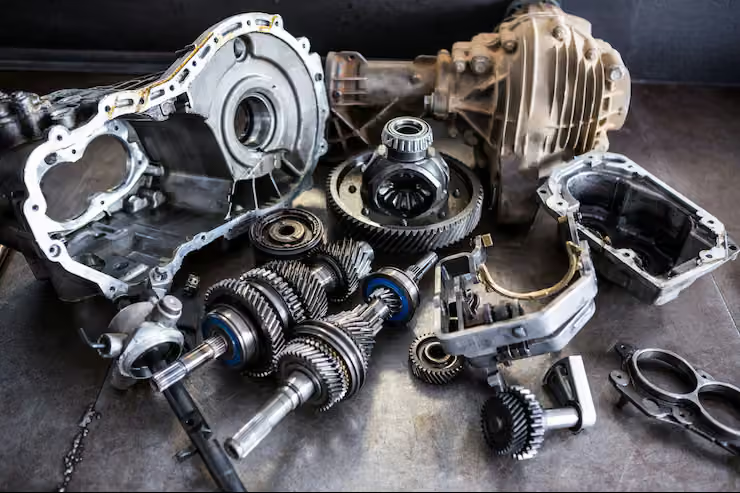
This gap is significant because an end-of-life vehicle is far more than scrap metal. Vehicles contain batteries, fluids, plastics, glass, rubber, copper, aluminum, steel, catalytic materials, and reusable components. When processed informally, these materials can become environmental hazards and introduce unsafe parts into the market. When managed correctly, they represent valuable industrial inputs and supply chain opportunities.
Nigeria illustrates both the challenge and the potential. The country's extensive used-vehicle fleet has helped create a thriving informal spare-parts economy, but formal recycling infrastructure has remained limited. Key systems such as authorized treatment facilities, vehicle databases, roadworthiness monitoring, and structured deregistration processes have not been widely established. In response, authorities have begun implementing End-of-Life Vehicle Waste Recycling Regulations aimed at identifying, deregistering, dismantling, and responsibly disposing of aging and non-functional vehicles.
The economic case for reform is compelling. Nigeria’s National Automotive Design and Development Council has associated the initiative with the potential creation of more than 40,000 direct and indirect jobs. Policymakers have also highlighted revenue opportunities from the recovery and resale of metals, batteries, and other reusable materials. A properly structured recycling sector could support an extensive ecosystem of collectors, dismantlers, recyclers, material processors, certification providers, and environmentally focused manufacturers.
South Africa faces a related but distinct challenge. While the country has a more developed salvage and used-parts market, the pathway from insurance write-off to fully compliant recycling remains inconsistent. Depending on a vehicle’s condition and registration status, written-off vehicles may be rebuilt, auctioned, dismantled for parts, or scrapped. Weak traceability, fragmented enforcement, and varying levels of insurance coverage can allow vehicles and parts to move through informal channels.
The concern extends beyond environmental impact. Vehicle identity fraud remains a persistent issue. Although microdotting has been mandatory in South Africa since 2012, cloned vehicles can still enter the market when verification processes confirm only that a vehicle identification number exists within a database, rather than confirming that the physical vehicle matches the registered identity.
For this reason, vehicle recycling cannot be treated as a standalone policy issue. Effective recycling depends on integration with registration systems, law enforcement databases, insurance workflows, dealer compliance mechanisms, and vehicle ownership records. Trustworthy recycling and parts markets require certainty around vehicle identity, clear deregistration pathways, and regulatory frameworks that support formal investment while discouraging informal practices that operate outside compliance standards.
International organizations expect the challenge to intensify. The United Nations Environment Programme projects that Africa’s vehicle fleet could grow by four to five times by 2050, with between 80% and 90% of that growth likely to come from imported used vehicles. The United Nations Road Safety Fund has also reported that more than 1.45 million used light-duty vehicles were imported into Africa from the European Union, Japan, and the United States during 2018 alone.
Addressing this reality will require a comprehensive end-of-life vehicle strategy that goes well beyond traditional scrapyards. Essential components include digital vehicle records, clear write-off categories, mandatory deregistration procedures, accredited collection facilities, depollution requirements, certified dismantling operations, parts traceability systems, customs oversight, and incentives that encourage vehicle owners to retire obsolete vehicles responsibly. Policymakers must also incorporate informal operators into formal, traceable, and tax-compliant structures rather than excluding them from the process entirely.
The potential rewards extend far beyond cleaner scrapyards and waste reduction. A formal automotive recycling industry could lower dependence on imported replacement parts, support affordable vehicle repairs, strengthen metals and materials supply chains, reduce illegal parts trading, improve road safety, create green employment opportunities, and help prepare African economies for growing numbers of hybrid and electric vehicles that require specialized battery and electronics recycling.
Africa’s aging vehicle fleet is often viewed as a burden. With the right combination of policy, enforcement, infrastructure, and private-sector investment, it could become a foundation for circular industrial growth. The continent does not lack vehicles reaching the end of their life cycle. What it lacks are the systems needed to transform those vehicles into lasting economic value.