Painting plastic bumpers is a common occurrence in body shops across the region, and none more so than new bumpers. In fact, the global plastic bumper market is expected to grow at a compound annual growth rate of 5.5% from 2022 to 2030.
Paul Retief, Training and Technical specialist, Axalta Refinish South Africa, says: "Having a reliable, fast and consistent process to carry out these new plastic part repairs is vital for body-shop efficiency. That’s why Spies Hecker has a straightforward, step-by-step guide for preparing them. It incorporates a versatile primer surfacer, available in three colours – including pure white - that’s suitable for wet-on-wet application, direct to plastic, without the need for pre-priming, and an overcoat time of just five minutes.”
Step oneStart by tempering the new, unprimed plastic bumper, or other new plastic part, for 60 minutes at 60oC to 65oC. Always check the heat resistance of the plastic part to avoid any deformation. This step brings any remaining release agents to the surface of the new plastic part and will make its cleaning and preparation much easier.
Retief says: “To help save on energy costs, if you plan ahead, place the bumper in the spray booth as you dry another job.”
Step twoClean the tempered plastic part with an appropriate plastic cleaner or silicone remover, such as Permaloid® Silicone Remover 7010 and the ultra-fine Fleece Pad from Audurra – the Axalta accessory brand. Wipe the surface to loosen and lift any contaminants. This removes the release agents thoroughly.
Step threeClean again with the Audurra Degreasing Cloth moistened with an appropriate plastic cleaner or silicone remover, such as Permaloid Silicone Remover 7010. Thoroughly wipe off with a clean cloth – change cloths if required – and let the bumper or new plastic part stand for a while to allow for any residual solvent to evaporate from the plastic substrate.
Step fourTack, rag and blow with a stat gun, which eliminates static and neutralises any charge on the plastic so that subsequent paint layers will be able to flow into every crevasse.
Step fiveUsing Permasolid® Speed-TEC Speed Plastic Additive 9260 with Permasolid Speed-TEC HS Speed Surfacer 5500 or with Speed-TEC HS Wet-on-Wet Surfacer 5550 provides the adhesion and flexibility required when painting plastic parts without compromising on the quality and performance.
Retief says: “Permasolid Speed-TEC Speed Plastic Additive 9260, part of the Spies Hecker innovative Speed-TEC system, starts to give refinishers benefits straight away. It aids the adhesion to the plastic and it flexibilises the surfacer into which it is mixed. This is a vital way to save time as it means one step less in the mixing process and one less product needed.”
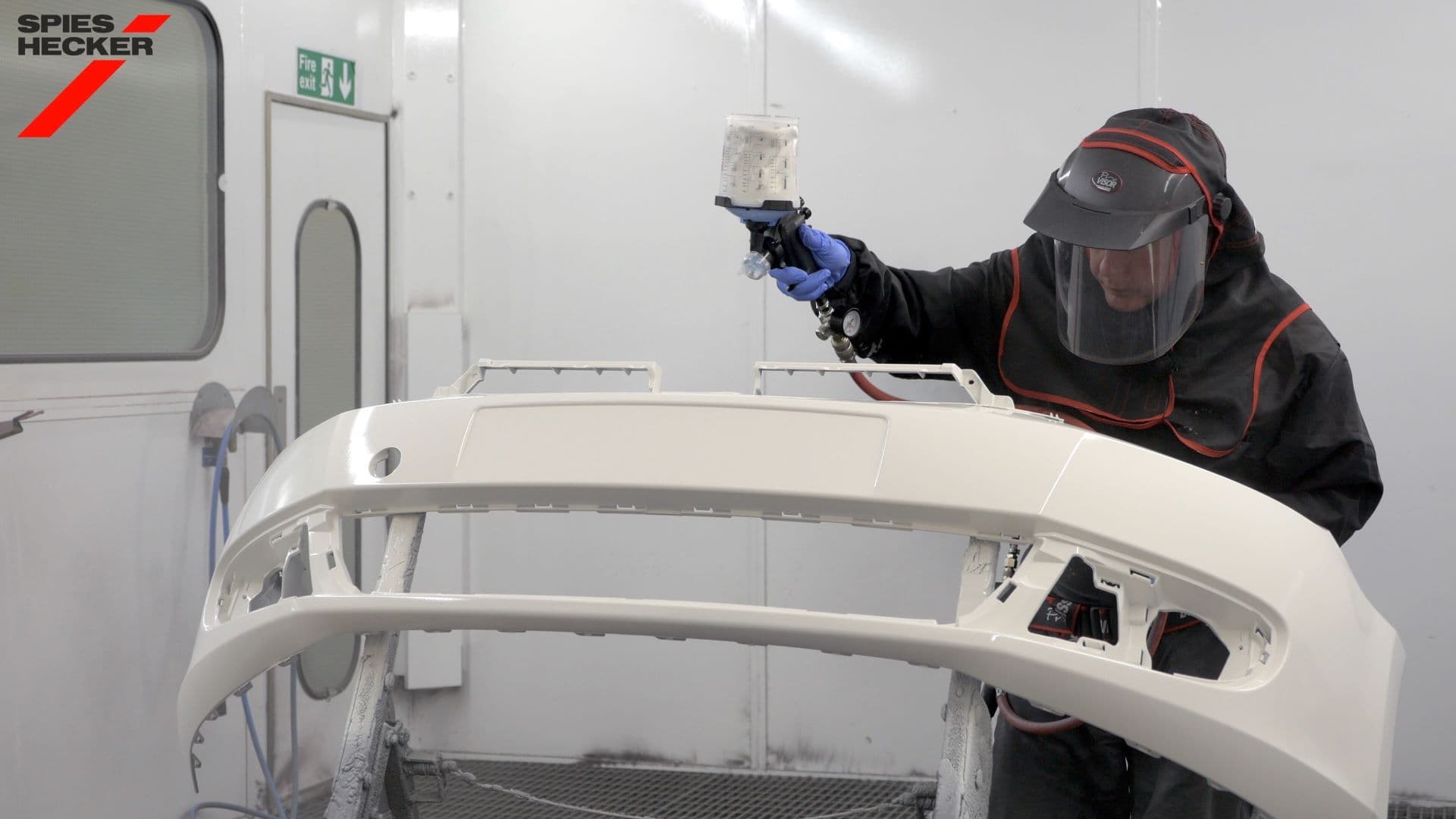
Retief recommends a topcoat gun set up – 1.3mm or 1.4mm – for the best lay-down of the primer surfacer, including an inlet pressure of 1.5 bar to 1.8 bar and around 22 psi to 26 psi.
“For the white, two full coats are required, which are applied wet-on-wet. For the black and grey, refinishers only need to apply a half coat followed by a full coat for optimal coverage,” Retief explains.
Step sixAfter only five minutes of drying, the new plastic part can be denibbed to remove any dust inclusions using the ultra-fine (blue) double-sided Audurra Sanding Sponge Flex. The new plastic part is now ready for the basecoat application.
Retief concludes: “Using this process, without the need for the extra step and material of a primer really ensures the Speed-TEC System lives up to its name. Our refinishers can confidently tackle new plastic parts, quickly and efficiently, thanks to our innovative products and the Audurra range of accessories to support every body-shop process.”
To find out more about preparing new plastic parts, watch the dedicated Spies Hecker Video-TEC seven-minute video here. For the full series of videos, visit the Spies Hecker YouTube channel at www.youtube.com/SpiesHecker