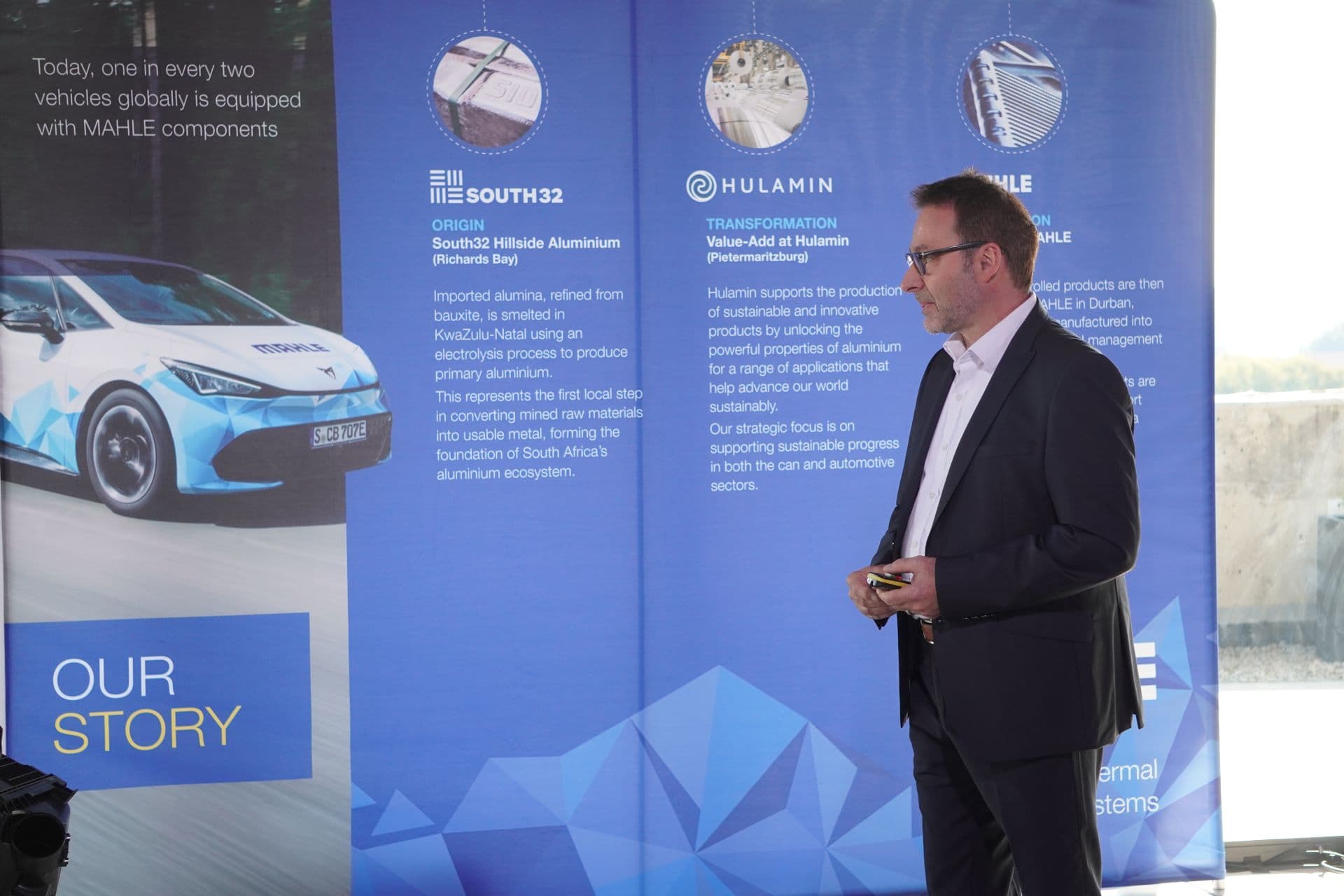
Africa’s automotive future should not be shaped by a single technology path, according to Juergen Wolf, Managing Director of Mahle in South Africa.
Speaking at the company’s International Media Tech Day on 3 June, he argued that the continent’s next phase of industrial growth will depend on flexibility, local production and a more coordinated regional strategy.
Wolf’s central point was that Africa is no longer simply an import destination for vehicles. He said the continent is beginning to create its own automotive future, driven by population growth, rising urbanisation and increasing demand for mobility. With forecasts pointing to the possibility of 5 million vehicles being produced across Africa by 2035, he sees the sector as one of the continent’s most important industrial opportunities.
For Mahle, that opportunity aligns with a business that has evolved far beyond its origins. Founded in 1920 and based in Stuttgart, Germany, Mahle is now one of the world’s major automotive technology suppliers. The company focuses on electrification, thermal management and technologies that improve the efficiency of internal combustion engines while reducing emissions. According to Mahle, its components are used in one out of every two vehicles worldwide. It has 127 production locations, around 64,000 employees and annual sales of 11.3 billion euros. In South Africa, the company has operations in Durban and Gqeberha.
Wolf said this global scale matters because Africa’s transition will not mirror Europe or China. Instead of betting on one route to cleaner mobility, he made the case for technological diversity. In practical terms, that means electric, hybrid, hydrogen, sustainable fuel and efficient internal combustion technologies all have a role to play, depending on the realities of each market. Affordability, energy supply, infrastructure and customer needs vary too widely across the continent for a one-size-fits-all approach.
That position plays to Mahle’s strengths. While the group is often associated locally with air conditioning and engine cooling products, Wolf stressed that the company’s wider capabilities extend across powertrain systems, charging, filtration, thermal and fluid systems, and lifecycle mobility services. In his view, that makes Mahle well placed to support a market where several technologies are likely to coexist for years to come.
South Africa remains central to that plan. Mahle supplies six of the country’s seven vehicle manufacturers and exports roughly half of its local revenue, including aluminium tube products that go to markets such as the United States, Mexico, Asia and Europe. Wolf said the company now wants to expand beyond its traditional thermal systems base by adding products such as air cleaners, oil filter modules, cylinder head covers and oil pans. In a domestic market that is not growing quickly, broadening the local product mix is one way to unlock new volume.
Even so, he did not hide the challenges. Wolf said South Africa’s vehicle production remains well below long-held ambitions, while imported vehicles from India and China are intensifying pressure on local manufacturing. He also pointed to falling local content, rising compliance costs for multinational firms and wider deindustrialisation risks. Although infrastructure performance has improved, he suggested the country would still need much stronger logistics capacity if it is to support significantly higher production levels.
Yet the tone of his address was not pessimistic. Wolf said new investment from brands such as Stellantis and Mahindra could help strengthen the local industry, while the African Continental Free Trade Area offers a potential route into faster-growing markets elsewhere on the continent. He also highlighted South Africa’s promise as a shared services base, noting its cost competitiveness, strong English capability and limited time difference with Europe. Mahle has already started testing that model.
On sustainability, Wolf said Mahle is pursuing clear decarbonisation targets, including major emissions reductions by 2030 and carbon neutrality by 2040. But he also acknowledged that supply chain emissions and coal-based electricity remain difficult issues in the South African environment.
His overall message was that South Africa still has a meaningful place in Africa’s automotive future, but only if it remains competitive, adaptable and regionally connected. For Mahle, the future will not belong to a single technology or a single market. It will belong to those able to respond to complexity with scale, investment and openness to change.