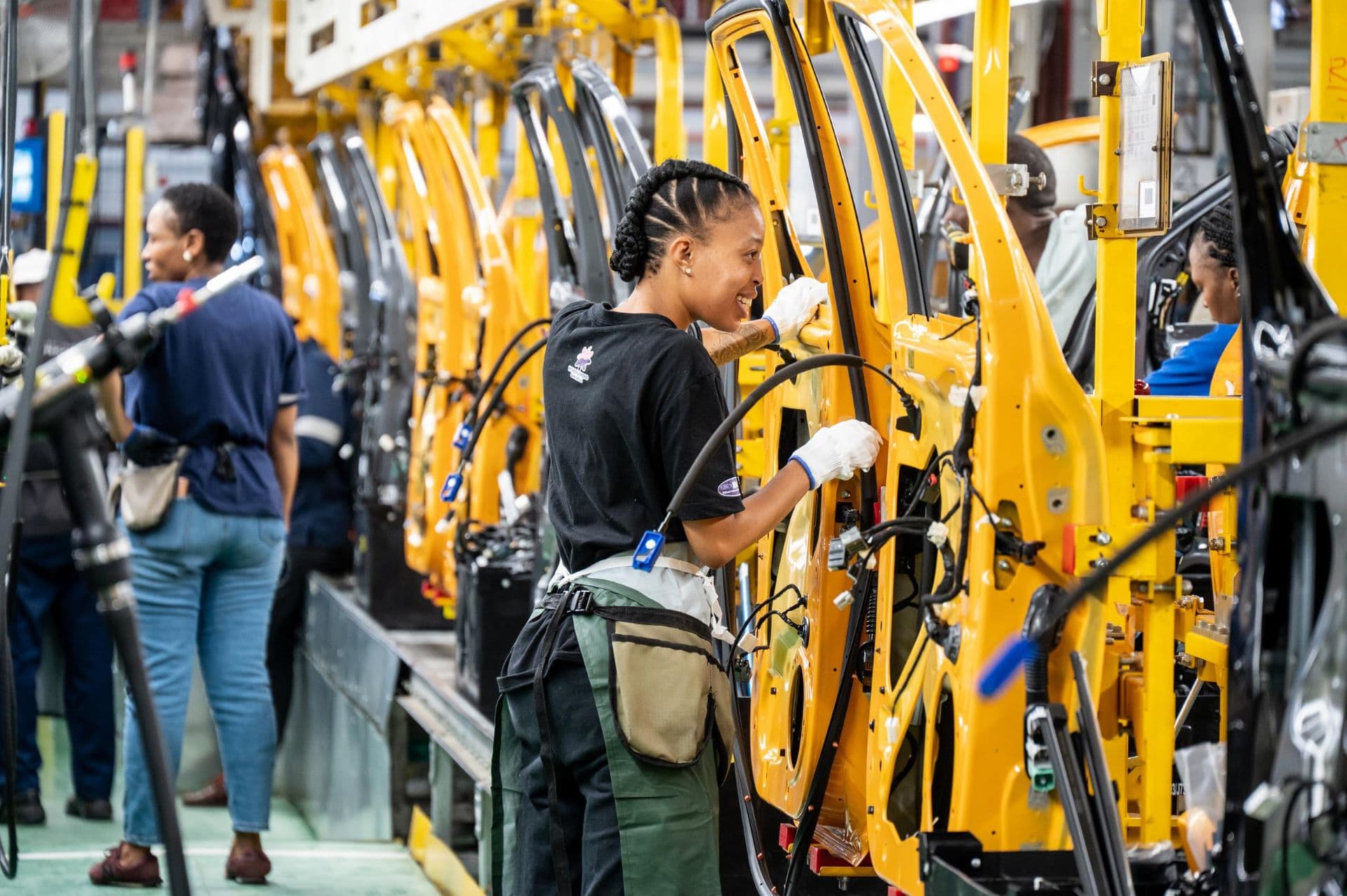
Working shoulder-to-shoulder with workers on the door assembly line at Ford’s Silverton Manufacturing Plant are two cobots (collaborative robots) responsible for the installation of weatherproof shields into Ranger doors, a process requiring pin-point accuracy, strength and dexterity.
This process does not replace employees but allows operators to use their time more efficiently on complex tasks, like installing wiring looms and avoiding suffering the strains associated with repetitive tasks.
With a reach of one metre, the UR10e cobots’ work is spaced out along the door assembly line. A sensor detects the arrival of the door and its millimetre-perfect positioning. This synchronisation ensures the precision of the path the cobot takes in the installation of the weatherproof liner.
Once the door is in position, the cobot, using a roller attached to its ‘wrist’, applies constant pressure to a pre-applied adhesive bead on the weatherproof liner, sealing it against the sheet metal of the door.
“The cobots know exactly how much force to apply (up to 5 kilogrammes) and can apply that force more easily and precisely than we can,” said Suresh Babu, Plant Manager Silverton Vehicle Operations. “They can follow a complex path avoiding any no-go zones on the door, ensuring the shield is completely sealed against water ingress. And they can do it the same every single time, which means we can achieve the quality expected.”
The installation of the weatherproof shield used to require a worker using a hand-held roller and applying considerable force to ensure the liner was completely sealed. This was hard, repetitive work that caused strain on wrist, elbow and shoulder joints. Not only has the cobot taken away this strain, improving the health and well-being of workers, it’s helped to improve quality and to speed up the installation process.
“Before the cobot was installed, it was hard work installing the weatherproof liners. The cobot doesn’t get tired or ever need a break. It’s made a big difference to quality and health on the line,” concludes Babu.