Brembo says its Sensify braking platform has entered series production with an unnamed global carmaker, a notable step for a technology long discussed as part of the move towards software-defined vehicles.
The Italian supplier says the system will be fitted across the full vehicle programme, suggesting the hardware and software are now ready for high-volume use rather than limited trials. The company also says it has signed further agreements that could see the system installed in hundreds of thousands of vehicles each year.
The significance reaches beyond one supplier contract. Carmakers are redesigning vehicles around centralised software, advanced driver assistance and increasing levels of automation. In that environment, braking systems that can be controlled digitally, monitored continuously and tuned wheel by wheel are becoming more attractive than older layouts built around hydraulic circuits alone.
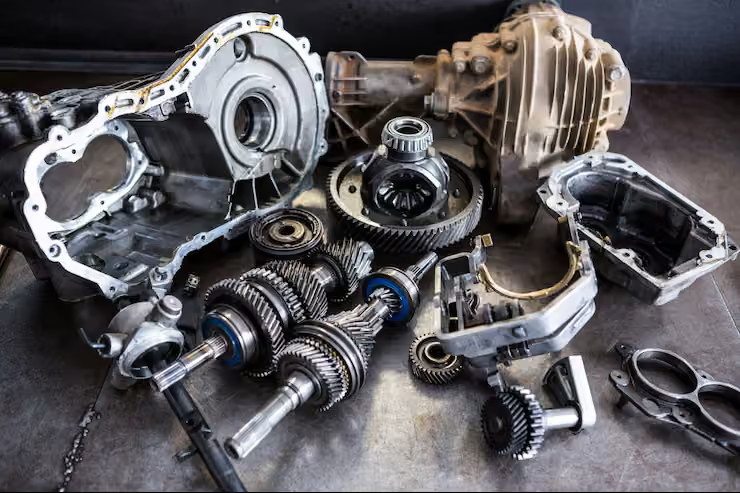
Put simply, a brake-by-wire system replaces much of the traditional mechanical and hydraulic connection between the brake pedal and the brakes with electronics, sensors, control software and actuators. When the driver presses the pedal, the request is interpreted electronically and the system decides how much braking force to apply at each wheel. In some current designs, hydraulics still play a supporting role. In more advanced layouts such as fluid-free electromechanical systems, the aim is to reduce or remove hydraulic circuits altogether.
The appeal is precision. Because the system can manage each wheel independently, it can adjust braking force more quickly and more accurately in response to grip, speed, steering input and vehicle balance. That can help improve stability in emergency manoeuvres, on wet or uneven roads and during complex interventions by safety systems. Modern brake-by-wire designs also rely on redundancy and fail-safe architecture, because braking remains one of the most safety-critical functions in any vehicle.
Brembo is positioning Sensify as a fluid-free, wheel-level intelligent braking platform that can support everything from advanced assistance features to future autonomous applications. The company says the system removes hydraulic circuits and centralised actuation, allowing braking forces to be modulated continuously at each corner of the car. That approach is intended to improve control while making the braking system easier to integrate into software-led vehicle architectures.
Electric and hybrid vehicles are helping to accelerate adoption. These vehicles already blend regenerative braking with conventional friction braking, and that handover is much easier to manage when software is coordinating the process. Brake-by-wire can therefore support smoother transitions, better energy recovery and more consistent pedal feel, while also fitting naturally with over-the-air software updates and the broader shift to software-defined platforms.
The wider industry is moving in the same direction. Recent reporting has highlighted growing interest in by-wire systems across steering and braking, especially in electric models and premium vehicles. Suppliers including ZF, Bosch, Continental and others are investing heavily in the category as manufacturers look for architectures that better support automated functions, cleaner packaging and software-based control.
Examples elsewhere in the market show how quickly by-wire thinking is spreading. Steer-by-wire systems are appearing in selected production vehicles, while brake-by-wire is becoming increasingly common in hybrids and battery-electric cars where digital control brings clear efficiency and integration benefits. That does not mean hydraulic brakes will disappear overnight, but it does suggest that the long-standing mechanical template for vehicle control is being steadily rewritten.
For Brembo, the production launch is both a commercial milestone and a signal about where vehicle engineering is heading next. If Sensify performs as promised at scale, it could strengthen the case for braking systems that are defined as much by code as by hardware. For the wider industry, it is another sign that the future of stopping a car may depend less on brake fluid and more on computing power.