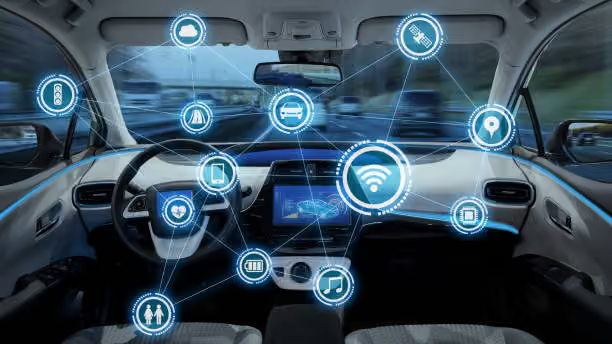
Already standard in cars, the use of functions such as wireless Apple CarPlay on a motorcycle display is not yet an everyday activity for riders. The Bosch TFT connect platform can link to a smartphone, so that the driver can safely store the phone away and still access apps on the display while riding. Additionally, the connection of a global navigation satellite system with the platform provides accurate location information. Because the system will support Linux and Android Automotive, manufacturers have more flexibility to adapt and integrate content, and so can offer riders more variety in the interface design and additional content. Another key function of the TFT Connect platform is its voice control option, which enhances safety and convenience for riders on the road. With this feature, riders can manage motorcycle settings like the ride mode just with voice commands. Other features can be managed via smartphone, using Siri or Google Assist: users can answer calls, dictate messages, operate the navigation system, or simply pick out a song completely hands-free.
More clarity and control with the new connected clusters from Bosch
The display on a motorcycle is more than the connection between bike and rider: it must be able to show relevant information for the ride at a glance, but also has to offer several features and options. And no matter if the sun is shining brightly or if the rain is pouring down, the information on the display must be clearly visible. The new Bosch display generation TFT connect offers high-resolution displays, advanced connectivity features, and a customizable interface. It sets a new standard for motorcycle instrumentation and boasts the highest contrast ratio and brightness on the market. With more than 16 million colors, brightness of up to 1,500 nits, and a contrast ratio of 1250:1, it allows crystal-clear and vibrant images in any weather. The display will be available in the sizes 7” and 10.25” at launch, but can also be adapted to different layouts and sizes. Also, the newly introduced touch interface is seamlessly integrated with the user interface and is designed to work with or without gloves in different weather conditions to provide riders with a personalized and comfortable user experience. Furthermore, the platform’s improved bootup times and system concept for displaying relevant information in less than a second ensure that riders can get on their bikes and set off immediately.
The Bosch TFT connect platform represents a step forward in motorcycle instrumentation, offering riders clarity, connectivity, and customization. With its advanced features and user-friendly design, the platform is set to enhance the riding experience for motorcycle enthusiasts around the world.
Handling the complexity of the future with the new Bosch central gateway
In an increasingly connected world, security is fundamental to avoiding unauthorized access to and tampering with vehicle components. Bosch’s central gateway for two-wheelers brings state-of-the-art security to the motorcycle and powersports world, safeguarding the other electronic control units in the vehicle’s trusted zone, ensuring rider safety, and helping to comply with upcoming cybersecurity regulations.
Bosch’s gateway platform is prepared to serve a large variety of vehicles in a range of sizes. Also, it’s designed to be constantly active and includes additional vehicle inputs and outputs; this makes it possible to deliver further features, turning it into a true gatekeeper for the entire vehicle. Functions such as over-the-air updates, remote function activation, connected safety functions, and vehicle tracking can be hosted on the gateway. Furthermore, the gateway can enable secure smartphone-based keyless systems, in which the rider can unlock the vehicle with their smartphone hands-free. This will open up new ways to make the riding experience more personalized and to improve riders’ daily life. With its versatility and functions, Bosch’s gateway for two-wheelers serves as a basis for future architecture upgrades.
“The technology Bosch delivers for greater security in connectivity and data exchange is laying the basis for new services and connected assistance and comfort functions. This brings us closer to our goal of shaping the future of riding,” Liersch says. “It’s exciting to be part of an ever-evolving industry, and Bosch is consistently driving forward the development of new motorcycle technologies in both software and hardware to ride at the very forefront.”