Bodyshop News Africa recently attempted to gauge the state of the collisionrepair industry in South Africa as we approach the end of 2024.We did this over the course of three separate interviews with different stakeholdersthe industry.

HALO is an independent NPC established by seasoned MBR industry professionals with the sole focus of restoring the balance of power between Motor Body Repairers and their trading partners, especially Insurers.
HALO is only at early stages of its existence and is building membership in all of the main metro centres. We successfully stopped the SAFIRE insurance group from initiating a direct parts purchasing deal with a major Dealer Group, and this will be a focus of HALO, essentially to restore the direct business relationships and remove any intermediary that is leeching from our profits. The industry cannot afford any further fiscal regression, or we will lose businesses, and in the South Africa context we need to grow small business and to do that the investment needs to be attractive.
HALO is developing a digital portal that will aid MBR businesses to resolve everyday challenges they face in their businesses, and the early stages will be launched during the last quarter, but it will grow to its full potential during 2025.
HALO will reopen the challenge to SAIA and its Insurer members to make available all the details of written-off vehicles in South Africa on a free-to-access e-portal. SAIA agreed in February 2022 to create this platform and make the information available. Since then it has reneged on that in-principal agreement. This cannot be allowed to continue as one cannot apply the rule of caveat emptor when the information required to inform your purchase decision is intentionally hidden.
HALO will first focus on its well-delineated programmes. We will, however, gladly partner with any association if the intent of the proposed action is to restore the balance of power for MBR and the industry as a whole.
The MBR industry is being threatened by large corporates who are intent on profiting in areas that are not their domain. These and the intermediaries who are leeching from our profit margins without contributing productively to the growth of the industry. Unless the traditional trading partners find efficient ways to return to the direct business relationships the industry is under great threat. Of course it should not be. The power lies with the MBR – without their investment, the technical expertise required to repair accident-damaged vehicles, none of the products, parts, paint, equipment, auditing firms and not even short-term motor insurers and brokers would exist!
The South Africa MBR industry is, by international standards, very advanced, and many businesses are already geared to repair these vehicles. The adjustments require training in the management of the ‘electrified’ whilst in your possession both to protect the artisans working on it and the vehicle itself, however the challenge is not formidable. Whilst the SA-based OEMs have already been required to adjust their manufacturing programmes to satisfy the regulatory frameworks and demands of their export destinations, the commercial viability of these vehicles and the security challenges of the South African landscape will stunt potential growth in the short to medium term.
This will be one of HALO’s key focuses. Substantial development of training programmes is needed, and the recent changes in the apprentice programmes will aid this. The industry in SA needs MANY more trained artisans, and our view is that these skills are also needed elsewhere in the world and even training in excess of local needs will bolster local employment by way of the export of skilled artisans. HALO will require all members to have apprentices in their employ and work closely with industry training entities to ensure these programmes are supported and developed.
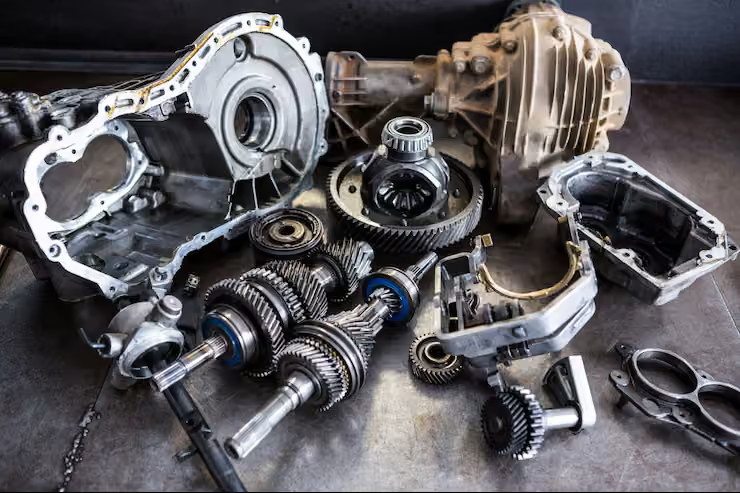
The shortage of containers has affected the cost of importation, which has resulted in a decline in alternative part quality, as suppliers have had to find alternative sources to fulfil contractual supply contracts. Several OEM and Dealer groups have also struggled to maintain their pick rates. This presents a threat to their businesses long term as MBR has had to adjust their businesses to repair more, resulting in part sale losses. HALO has a proposal on the table that will hopefully enhance the use of OEM parts, which offer several benefits in form fit and function, which translates into a happier client, however OEMs will have to sacrifice price to ensure this works.
HALO cannot affect the part supply problem; this is the domain of OEMs, and all we will do is adjust to the circumstances that are technically competent to do. HALO is already engaged with OEMs to seek solutions.
HALO’s view is that Insurers need to reduce their focus on their motor books and, like any other business, including MBR, focus on their overall profitability. To an extent, insurers use their motor book losses as a ploy to ‘convince’ repairers that they need to earn less and that is unacceptable. MBR needs to make a good return on their investment, not be corralled into being insurers’ lackies. HALO will work with insurers to find creative mechanisms to allow both to profit from their efforts, however any further regression in profit will be robustly defended.
The South Africa MBR industry is very advanced in these areas, and I believe could be favourably compared to several more developed countries. The challenge is always and remains the viability of programmes to ensure compliance, and insurers have a big role to play. MBR cannot conform to these regulations unless they are remunerated properly.
HALO digital portal will enhance the knowledge base of the smaller businesses in the sector. The MBR is no different from other areas of business, if you are trained, informed and make work of the application of that knowledge in your business, you will succeed. HALO will ensure that this help is at hand for every member. HALO will be the voice of these smaller businesses and ensure they receive the representation that allows them the freedom to succeed in their chosen field.
It is essential that the MBR industry remains focused on this element. See comments above regarding training.
The MBR industry is no different from many other business sectors – consumers rely on reputation and accredited status to receive the best quality of repair and service. HALO will engage with consumers to enhance their understanding of the repair process, however more importantly, our members are focused on delivering excellent quality and service, which is more important to the clients than intimate knowledge of the inner workings of the repair process.
The biggest opportunity is for MBR to realise that they hold the key to their successful future and not the insurer partners. HALO will play an important role in ensuring this outcome for its members.
The biggest threats are from insurer business partners who have a singular focus on profit at all costs and in achieving that focus lose sight of the absolute necessity of a strong and well-funded MBR sector, without which they will suffer the most in the long term.
The SA industry requires more competition in the digital estimation sector. Audatex, although an excellent system that HALO fully supports, competition is healthy and at present there is none. Digital estimation has been around for quite some time in the SA MBR market and is welcomed in any form as long as it is a productive contribution to our businesses.
As previously mentioned, HALO supports the use of OEM parts as they allow for quicker and more efficient repair cycles owing to their fit form and function. The tension exists more between insurers who are focused on reducing costs and the price of OEM parts. Good quality parts and the exclusive use of OEM parts in any repair that involves safety critical components are essential, and some insurers are ignoring these elements in favour of reduced costs. This is a threat to client safety and asset value, and clients need to be aware of these elements and acquire insurance for their vehicles from responsible insurers.
OEMs and industry groups are working towards standardising data formats. Repair shops will find it easier to access and interpret vehicle data, facilitating more accurate diagnostics. Many manufacturers are developing platforms that integrate telematics data directly into repair management systems. This allows for real-time access to vehicle health reports, fault codes and maintenance histories. With connected vehicles, motor body repairers will be able to conduct remote diagnostics and identify issues before the vehicle arrives for repair. This can streamline the repair process and minimise repair time. As this technology evolves, training programmes will need to be updated to ensure that technicians are equipped with the skills needed to interpret telematics data effectively.
Vehicle data can contain sensitive information about driving habits, locations and personal preferences. Protecting this data from unauthorised access is crucial to maintain consumer trust. There will be questions about who owns the data generated by a vehicle. What will be essential is that all industry role players would need to develop policies on consumer consent for data collection and usage. Connected vehicles are potential targets for cyberattacks. Industry will have to implement robust cybersecurity measures to protect against unauthorised access and manipulation of vehicle systems. Transparency in data-sharing practices is necessary to address consumer concerns. There is a risk that personal data could be shared with third parties without the owner's explicit consent. The navigation of varying data protection regulations will complicate data management processes. It is vital that legislation is clear on this subject.
In conclusion, the shift towards connected vehicles offers significant opportunities for improving repair processes through enhanced data utilisation. However, addressing privacy and security concerns is essential to ensure consumer confidence and safeguard sensitive information. Balancing innovation with ethical considerations will be crucial as the industry moves forward.
POPIA is a challenge that requires clarity. Insurers and OEMs are currently at loggerheads about whose information it is and HALO’s view is that the regulatory authorities need to rule on this so that everyone has clarity and manage the data correctly. HALO will lobby at the highest levels to ensure this happens.