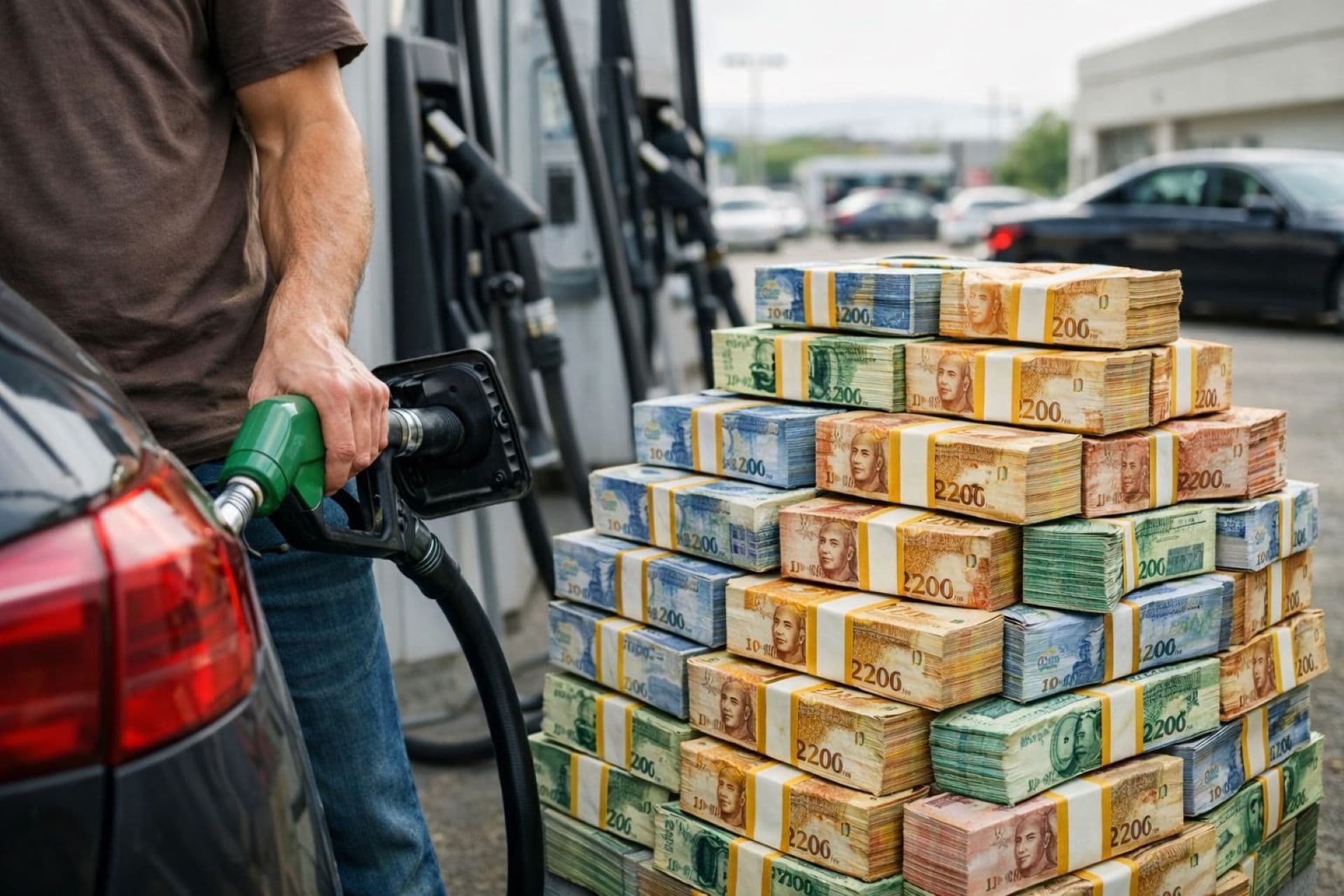
South Africans face one of the steepest fuel price increases in recent memory from Wednesday, as a perfect storm of rising global oil prices, a weakening rand and a ballooning slate levy conspire to push petrol and diesel to record highs.
For motorists and households already stretched thin, the timing could hardly be worse.
The latest adjustments, announced by the Central Energy Fund on behalf of the Department of Mineral and Petroleum Resources, point to a significant rise in both petrol and diesel, while users of gas and paraffin are also not spared.
The increases, which come into effect on 6 May 2026, are substantial and will be felt immediately at the pumps and in household budgets.
What is changing from Wednesday:
- Petrol 93 and 95 will increase by R3.27 per litre
- Diesel (both grades) will rise by R6.19 per litre
- Illuminating paraffin (wholesale) climbs by R4.22 per litre
- LPGas increases by R5.07 per kilogram
This means inland petrol 95 will now sit at around R26.63 per litre, up from roughly R23.36, while diesel wholesale prices push above R32.00 per litre depending on the grade.
The scale of the increase is largely driven by higher international oil prices and a weaker rand, both of which pushed up the Basic Fuel Price during the review period.
At the same time, government has kept a temporary fuel levy relief in place for petrol, while increasing relief on diesel to R3.93 per litre, in an effort to soften the blow slightly. However, this has not been enough to offset the overall rise.
A major additional contributor is the slate levy, which has been increased to R1.23 per litre to recover a large under recovery balance in the fuel price system.
How the fuel price is made up
Fuel prices in South Africa are made up of several regulated and market driven components. Petrol, in particular, is tightly controlled, with margins and pump prices set by government.
Recent fuel price trend (selected months)
| Date | Petrol 95 Inland | Diesel Inland |
|---|---|---|
| Apr 2026 | R23.36 | R25.91 |
| Mar 2026 | R20.30 | R18.54 |
| Jan 2026 | R20.75 | R18.42 |
| Oct 2025 | R21.63 | R19.34 |
| May 2025 | R21.40 | R18.90 |
| May 2026 | R26.63 | R32.10 |
The latest increase reinforces how sensitive local fuel prices are to global oil markets, currency movements and domestic levies. For consumers, the result is clear: from Wednesday, filling up a tank or buying gas will cost significantly more, adding further strain to already tight household budgets.