The proposed tariffs on imports from Mexico, Canada and China are concerning across the world, as they could lead to higher prices for American consumers and disrupt trade relations with important allies of the US, writes Greg Horn, Chief Industry Relations Officer at PartsTrader .
Horn had the following to say in his recent blog.
“Here’s what we know so far about the proposed tariffs:
All Imports (Including from Taiwan): A flat 10% tariff on all goods entering the US.
Canada and Mexico: A 25% tariff on imports, primarily targeting issues related to illegal drugs and immigration.
China: An additional 10% tariff on top of existing duties, focusing on trade imbalances and fentanyl exports.
BRICS Nations (Brazil, Russia, India, China, South Africa): A potential 100% tariff if these nations attempt to introduce a new currency to challenge the US dollar.
The implementation of these levies would likely hinder any prospects of a decline in car insurance premiums, despite a decrease in insurance losses this year following a period of heightened pricing. In 2023, the average premium saw a substantial increase of around 20%, as reported by the Insurance Information Institute. This suggests that consumers may not see the relief they were hoping for in terms of stabilisation of car insurance costs, should these levies come into effect.
The proposed tariffs on countries importing goods to the US by the Trump administration will increase the cost of parts, which make up roughly 43% of the average total collision repairs paid by insurers.
As a result, insurers are likely to pass on these additional costs to consumers through rate increases. This means that consumers may see higher insurance premiums as a result of the tariffs. It’s important for consumers to be aware of these potential impacts on their expenses, as insurers will undoubtedly pass those additional costs on to the consumer through rate increases.
About 60% of replacement parts used to repair cars in the US are imported, mainly from Mexico, The People’s Republic of China and Canada, said Bob Passmore, vice president for the American Property Casualty Insurance Association. New tariffs would increase the cost of parts, which account for about 40% of the average total repair bills borne by insurers and would prompt them to eventually increase rates, he said.
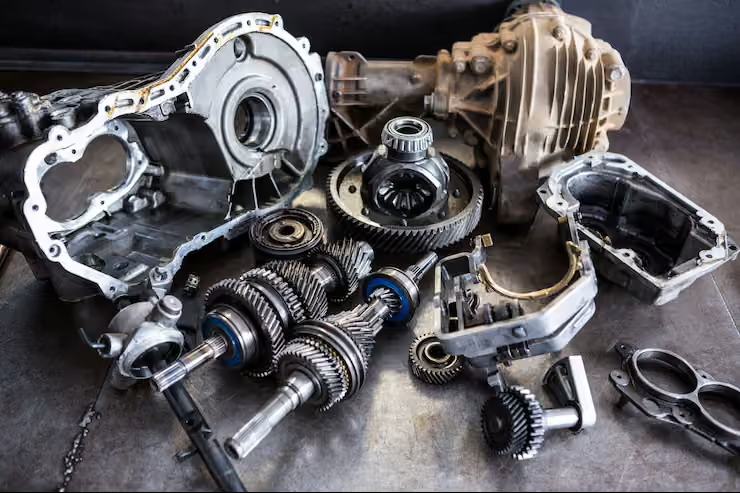
The production and supply chain of collision parts for vehicles are a complex and global process. Sheetmetal collision parts for domestic and import vehicles are typically stamped in Mexico and Canada before being shipped to the US for new vehicle assembly and collision repair. Additionally, many critical components such as electrical components, airbags and ADAS sensors are manufactured in The People’s Republic of China.
With the current political climate, the imposition of tariffs on Taiwanese semiconductors could have a ripple effect on the availability and cost of aftermarket collision parts manufactured in Taiwan. This means that the OEM parts could be the most impacted at this time. The interconnected nature of global supply chains means that any disruptions or tariffs can have a significant impact on the availability and cost of vehicle collision parts for consumers and repair shops.
But is the threat of tariffs just part of a negotiation?
The proposal of increased tariffs may not be just a negotiation tactic, but it could also be a part of a larger strategy to open new talks with the countries affected. The Canadian and Mexican governments have already engaged in private conversations with President-elect Trump in response to the proposed tariffs. The potential impact of a possible 25 percent tax on Canadian products has prompted Ontario Premier Doug Ford to consider retaliatory measures, including the possibility of cutting off energy exports to the US. This demonstrates the serious implications of the proposed tariffs and the potential for them to escalate into a trade dispute. These actions are more than just a negotiating tactic, as they have the potential to significantly impact the automotive industry and the relations between these countries.
It’s interesting to see how the threat of tariffs is affecting international negotiations. It’s a complex situation, especially with the involvement of President-elect Trump and his promised 25 percent tax on Canadian products. It makes you wonder if this is all just part of a larger strategy to open new talks and negotiations with these countries. And the fact that so many automotive parts are manufactured in Mexico, Canada and China adds another layer of complexity to the situation. It will be curious to see how everything unfolds and how these negotiations will ultimately impact the automotive industry. “