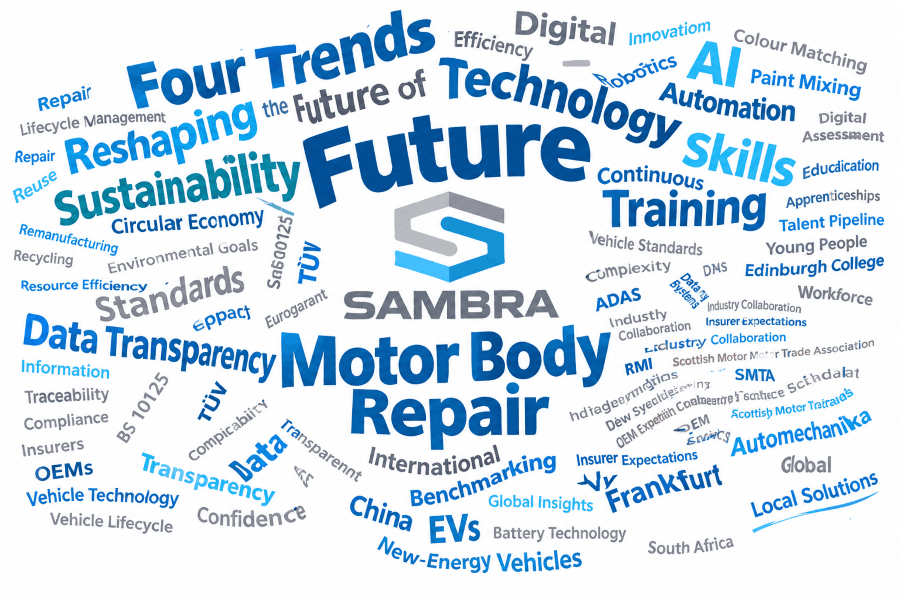
The future of motor body repair is being shaped by far more than what happens inside the workshop. Advances in technology, evolving skills requirements, sustainability goals and growing demands for data transparency are fundamentally changing how the industry operates.
These were among the key themes to emerge from the South African Motor Body Repairers’ Association’s (SAMBRA) September 2026 international benchmarking tour, which included visits to Automechanika Frankfurt, the AIRC Conference, the Scottish Motor Trade Association (SMTA) and Edinburgh College.
According to Juan Hanekom, National Director of SAMBRA, a proud association of the Retail Motor Industry Organisation (RMI), the trip highlighted the need for South African repairers to prepare for an increasingly complex and connected automotive landscape.
“Motor body repair is no longer a standalone activity,” says Hanekom. “Repairers are being influenced by environmental requirements, vehicle lifecycle management, insurer and OEM expectations, data systems and rapidly advancing vehicle technology. While every market is different, many of the challenges are remarkably similar.”
Technology is Enhancing Skills, Not Replacing Them
Artificial intelligence, automation and digital technologies are becoming increasingly common in collision repair environments. Automated paint mixing, robotic paint application, digital colour matching and AI-assisted damage assessments are already helping workshops improve efficiency and consistency.
However, Hanekom emphasises that technology alone is not the answer.
“The discussion is not about replacing skilled technicians. The real opportunity lies in using technology to support people, improve productivity and help businesses manage growing technical complexity,” he explains.
For South African repairers, the challenge will be identifying which technologies offer genuine value and ensuring employees have the skills needed to use them effectively.
Continuous Training is Becoming Essential
Modern vehicles are becoming increasingly sophisticated. Electric vehicles (EVs), advanced driver assistance systems (ADAS), new materials and software-driven technologies are changing the knowledge required to assess and repair vehicles safely.
International experience suggests that traditional apprenticeships and qualifications are no longer enough. Ongoing training and regular skills updates will become critical throughout a technician's career.
The visit to Edinburgh College reinforced the importance of building a strong talent pipeline from an early stage. Attracting young people into technical careers, providing exposure to industry opportunities and creating pathways into employment are all vital for the long-term sustainability of the sector.
“Skills development cannot stop when someone qualifies,” says Hanekom. “Technicians need opportunities to continuously develop as vehicle technology evolves, while the industry must work harder to make repair careers visible and attractive to younger generations.”
Circular Economy Principles are Expanding Repair Opportunities
A growing focus on sustainability is placing greater emphasis on vehicle lifecycle management and the circular economy.
International discussions highlighted the importance of distinguishing between vehicles that can be safely repaired, those suitable for parts recovery and remanufacturing, and genuine end-of-life vehicles requiring recycling.
The principle of repairing, reusing and remanufacturing components wherever possible is becoming increasingly important as the industry seeks to reduce waste and improve resource efficiency.
“This presents an important opportunity for South Africa,” says Hanekom. “But any move towards greater circularity must be supported by strong standards for safety, quality, traceability and compliance.”
Data and Standards are Becoming Business Critical
As vehicles become more technologically advanced, access to accurate repair information is becoming essential. Reliable data, clear standards and proper documentation are increasingly central to determining how vehicles are assessed, repaired and returned to service.
International frameworks such as BS 10125, TÜV and Eurogarant provide useful examples of how standards can support repair quality, consistency and technical competence.
For repairers, this means having access to the correct repair procedures and technical information. For the wider industry, trusted data can strengthen confidence between repairers, insurers and vehicle manufacturers.
“Standards and data are no longer simply administrative requirements,” Hanekom notes. “They are becoming critical tools for proving that repairs have been completed correctly and in line with approved methods.”
Learning Globally, Preparing Locally
The benchmarking tour also highlighted the growing influence of China as a technology leader in areas such as new-energy vehicles, battery technology, automation and software-defined vehicles.
Yet even in developed markets, widespread EV adoption has not automatically resulted in widespread repair readiness. Skills shortages, equipment requirements and the implementation of repair standards remain ongoing challenges.
For South Africa, the lesson is clear: international trends provide valuable insights, but local solutions must be tailored to local conditions.
“The task is no longer simply to protect repairers from change,” Hanekom concludes. “It is to help them understand, adapt to and ultimately shape the systems that will define the future of motor body repair.”