The European Parliament has approved sweeping new rules aimed at making vehicles in the EU easier to reuse, recycle and recover at the end of their lives.
MEPs gave their final backing to the regulation on Thursday, 18 June 2026, following an agreement reached with the Council at the end of 2025. The law was adopted by 437 votes to 112, with 20 abstentions.
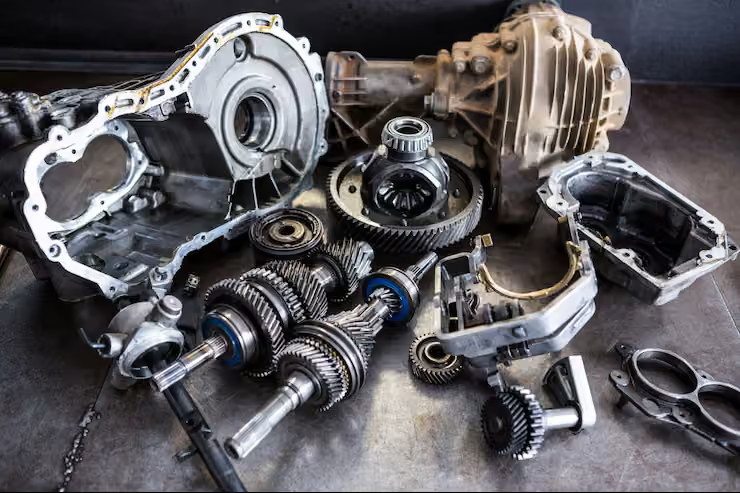
The measures cover the full lifecycle of a vehicle, from its design and production to its eventual dismantling or disposal. A key requirement is that new vehicles must be designed so that parts and components can be removed more easily, making repair, reuse and recycling more practical.
The regulation also introduces binding recycled-content targets for plastics used in new vehicle types. Within six years, at least 15% of plastics in each new vehicle type must be recycled material, rising to 25% within ten years. Of that recycled plastic, at least 20% must come from end-of-life vehicles or used parts, creating what is known as a closed-loop system.
The European Commission may later set similar targets for other materials, including steel, aluminium, magnesium and critical raw materials, subject to feasibility studies.
The rules will also affect the sale of used vehicles within the EU. Businesses selling a used vehicle will have to provide either an assessment showing that it is not an end-of-life vehicle or a valid roadworthiness certificate. Private sales will face lighter requirements, with documentation needed only where the vehicle has been declared a total economic loss or where the sale takes place solely through an online platform.
Manufacturers will also face greater responsibility once vehicles reach the end of their life. Three years after the rules enter into force, extended producer responsibility will require carmakers to pay for the collection and treatment of end-of-life vehicles anywhere in the EU.
The regulation further seeks to address the problem of “missing vehicles”, which may be illegally dismantled or treated outside proper systems. Five years after the regulation takes effect, vehicles declared non-roadworthy will no longer be allowed to be exported.
Jens Gieseke, of Parliament’s Environment Committee, and Paulius Saudargas, of the Internal Market Committee, said the rules would support the automotive sector’s shift towards a circular economy while improving resource security and environmental protection. They said the approach was designed to set realistic targets, reduce unnecessary red tape and promote fairer competition.
The regulation still requires formal approval by the Council. Once adopted, it will enter into force and start applying 24 months later.
The proposal was first put forward by the European Commission on 13 July 2023 as part of broader efforts linked to the European Green Deal and the circular economy action plan. In 2023, the EU produced 14.8 million motor vehicles and registered 12.4 million, while 285.6 million vehicles were on EU roads. Around 6.5 million vehicles reach the end of their lives in the bloc each year.