South African businesses are being urged to rethink how they view road safety. Crashes can no longer be regarded as isolated incidents that are simply resolved through insurance claims. The financial consequences extend far beyond repair bills, affecting productivity, reputation, employee wellbeing and long-term profitability.
According to road safety statistics, South Africa continues to experience some of the highest road fatality rates globally, with between 11 000 and 13 000 lives lost on the country's roads each year. While these figures highlight the human cost of unsafe roads, the economic impact on organisations is equally significant.
For fleet operators and businesses that rely on vehicles, the direct costs of a crash can be substantial. Previous research by the Road Traffic Management Corporation (RTMC) and the Council for Scientific and Industrial Research (CSIR) estimated the cost of a minor crash at tens of thousands of rand, while serious incidents can run into millions. Given inflation and rising operating expenses, the financial burden today is likely considerably higher.
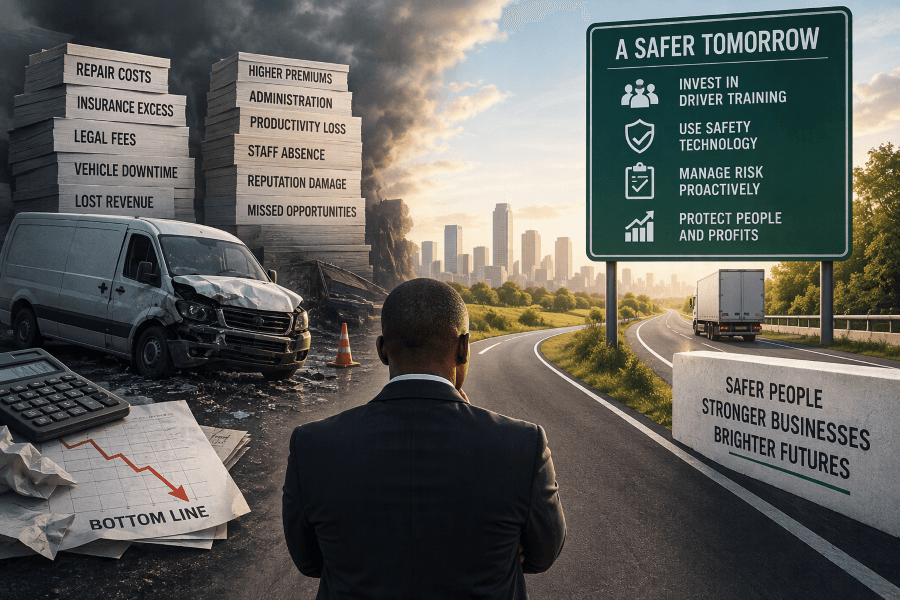
However, these visible expenses represent only a fraction of the overall impact.
According to Eugene Herbert, CEO of MasterDrive, direct costs such as vehicle repairs, insurance excesses and medical expenses are often the easiest to identify, but they tell only part of the story.
"Many organisations underestimate the scale of the indirect costs associated with a crash," says Herbert. "When a vehicle is off the road, deliveries may be delayed, appointments missed and customer relationships strained. The resulting disruption can affect revenue generation and operational efficiency long after the incident itself."
These hidden costs can quickly accumulate. Administrative time spent managing claims, legal processes and investigations places additional pressure on staff. If an employee is injured, businesses may also face recruitment costs, temporary staffing requirements, retraining expenses and reduced productivity during recovery periods.
Industry estimates suggest that for every rand spent on a crash-related expense, businesses may incur several times that amount in indirect costs. In sectors with extensive transport operations, the ratio can be even higher, turning seemingly manageable incidents into major financial setbacks.
Vehicle downtime, increased insurance premiums and lower employee morale further compound the problem. A serious collision can have ripple effects across an organisation, disrupting schedules and placing additional pressure on colleagues tasked with compensating for lost capacity.
Fortunately, businesses have an opportunity to change this trajectory. Companies that invest in driver training, safety technologies and comprehensive road safety programmes are increasingly seeing measurable returns. Research indicates that a combination of training and technology can significantly reduce collision rates, delivering savings that often outweigh the initial investment.
For Herbert, the conversation should no longer focus on whether organisations can afford to invest in road safety.
"The real question is whether businesses can afford not to," he says. "By shifting from a reactive approach to a proactive safety culture, organisations can protect lives, strengthen operational performance and safeguard their bottom line."