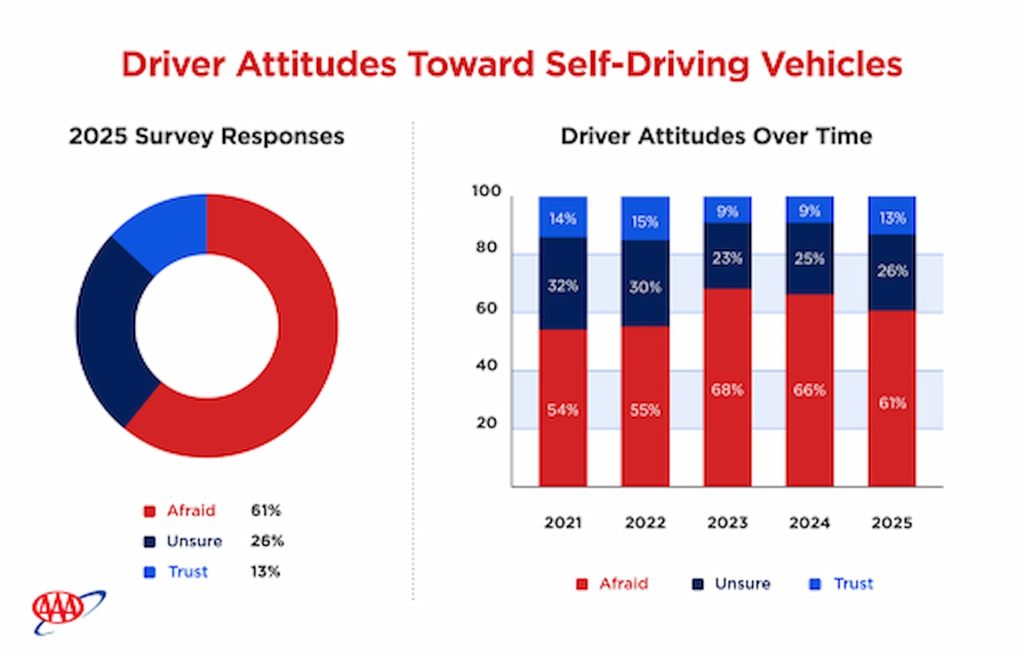
According to AAA’s latest survey on autonomous vehicles, 13% of U.S. drivers would trust riding in self-driving vehicles – an increase from last year, when this number was 9%. Despite this slight increase, 6 in 10 U.S. drivers still report being afraid to ride in a self-driving vehicle. For drivers, enhancing vehicle safety systems remains a priority over the development of self-driving, with interest among drivers decreasing from 18% in 2022 to 13% this year.
“Most drivers want automakers to focus on advanced safety technology,” said Greg Brannon, the automotive engineering director at AAA. “Though opinions on fully self-driving cars vary widely, it’s evident that today’s drivers value features that enhance their safety.”
Improving safety systems is important for U.S. drivers—78% prioritize advancements in safety systems as a top vehicle technology initiative—which has been steady for the past several years. In contrast, the excitement surrounding new vehicle styles is a low priority, with only 24% of drivers viewing it as important. Enthusiasm is also low toward the development of self-driving vehicles—only 13% of drivers consider this a priority, a decrease from 18% in 2022.
As of 2025, Robotaxis, self-driving vehicles used like a taxi or ride-share, operate in several major cities. AAA’s survey found that 74% of drivers were aware of Robotaxis, yet 53% said they would not choose to ride in one. Different demographics have varying opinions. Millennial and Generation X drivers are more likely to say they would ride in one than Baby Boomer drivers, but even among younger drivers, most say they wouldn’t ride in a Robotaxi.
Collectively, interest in advanced driver assistance features (ADAS) continues to remain high. The survey found that 64% of U.S. drivers would “definitely” or “probably” want Automatic Emergency Braking (AEB) on their next vehicle, 62% would want Reverse Automatic Emergency Braking, and 59% Lane Keeping Assistance. AAA believes that to maintain a growing interest in these features, the performance and naming of these systems must adequately reflect the intended benefits and capabilities of the systems.
“We are committed to collaborating with industry leaders and automakers to prioritize the safety and performance of advanced vehicle technology. AAA’s research insights are helping to shape safety standards and educate drivers to safely and confidently use these technologies,” said Brannon.
AAA believes addressing consumer concerns means transparency regarding ADAS performance with clear communication about its limitations. Advanced vehicle safety technology should enhance driver safety rather than give the impression that the car is driving itself. As these systems have been refined with upgraded software and sensors, AAA has conducted various tests to determine if the technology performs as expected. Research released by AAA in October 2024 showed significant AEB advancements, particularly at speeds up to 35 mph.