Picture a boxer taking a hard punch to the face, his head whipping around quickly after his opponent’s glove makes contact.
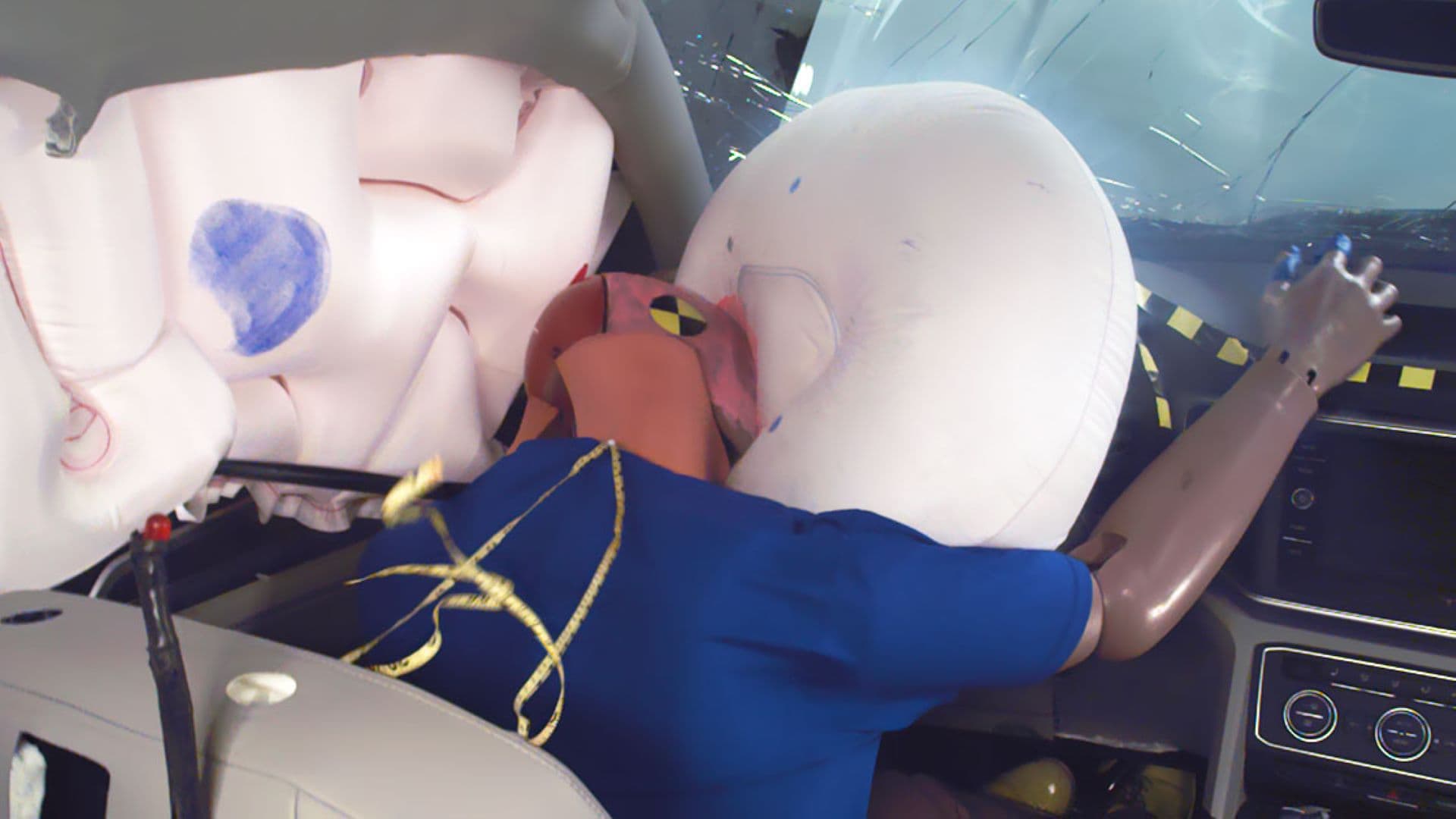
Drivers and passengers can experience similar rotational head motion during crashes in some vehicles. And just as with a person who gets punched in the face, that head-whipping movement can cause concussions and other brain injuries that aren’t immediately visible.
“Up until now, we haven’t had a good way to assess the risk of rotational brain injury as part of our crash tests. But thanks to a metric first adopted by the NFL for helmet evaluations, that is set to change,” says Becky Mueller, Senior Research Engineer at IIHS (Insurance Institute for Highway Safety)
“We are currently laying the groundwork to integrate this metric into our crash test criteria so that our ratings will provide a fuller picture of injury risk. This in turn will set the stage for airbag improvements that can reduce the risk of these types of injuries,” explained Mueller.
On the whole, modern vehicles do an excellent job of protecting vehicle occupants’ heads. In a frontal crash, for example, the frontal airbag will cushion a person’s head as it moves forward, preventing contact with any hard surfaces. That’s usually the end of the story, but occasionally the head will whip to the side after striking the airbag hard. We’ve seen this happen to the dummy in our crash tests; in the real world, while relatively infrequent, we see evidence of it in post-crash concussions and other injuries.
“To understand how we plan to measure this risk — and why we weren’t able to do it before — you first need to understand a bit about crash test dummies. Dummies are designed to be durable enough to withstand hundreds of high-speed crash tests. Unlike human bones, a dummy’s metal skeleton doesn’t easily break. For this reason, we rely on measurements recorded by sensors in the dummy to tell us how a human body would respond,” said Mueller.
Current crash test dummies can be instrumented with up to 200 sensors in the head, torso, arms and legs, providing engineers with a wealth of information about what the dummy experiences during a crash. These measurements can tell what kind of injuries would be possible or likely for a human in an identical crash.
“We use that information, combined with an assessment of the structure surrounding the occupants and observations of the movement of the dummy during the crash, to assign a rating based on crash test performance,” said Mueller.
Interpreting the measurements recorded by dummies relies on decades of injury biomechanics research. Some injuries can be characterized by a simple measure — for example, 1,400 pounds of combined pelvic force equates to a 45% risk of pelvic fracture. In scenarios in which combinations of forces, accelerations or rotations contribute to injury, a mathematical formula is used to interpret the contributing components.
Vehicle ratings using our current injury criteria have been validated by real-world crash data. People in vehicles with good ratings are less likely to die in crashes than in comparable collisions in poor-rated vehicles. The criteria have also helped automakers design safer vehicles. For example, they helped bring about the integration of airbags into vehicles, which have saved more than 70,000 lives.
“Among these metrics, the one we have always used for head injury is called simply the head injury criterion, or HIC. HIC measures the duration of head accelerations and was developed to assess the risk of skull fractures from hard impacts against vehicle interiors. In other words, it measures linear impacts, but doesn’t capture high-speed rotations like the kind I described above,” said Mueller.
In 2012, IIHS added rotational motion sensors to our dummy fleet and began investigating ways to interpret the data they collected. The first available metric was the brain injury criterion, or BrIC, a formula developed by the National Highway Traffic Safety Administration.
“My colleagues and I calculated BrIC for 150 IIHS small overlap front and moderate overlap front crashes but found the formula struggled to identify complex head motions observed during the tests. Where it did identify injury risks, it was often unclear how the airbag performance could be improved. We decided to wait for other criteria that would better fit our crash test scenarios
“A better option soon came along in the form of the Diffuse Axonal Multi-Axis General Evaluation (DAMAGE). This rotational head injury metric developed by the University of Virginia is used in combination with HIC to assess helmet performance in the NFL. It has also been used by the European New Car Assessment Program for its crash test ratings since 2022. We decided to take it for a test drive,” Mueller continued.
The original DAMAGE formula was based on the brain of an average man, which works with the 50th percentile male dummies we use. However, we also use 5th percentile female dummies in our crash tests, so we funded research that recalculated the brain strain tolerances for a small woman.
Applying DAMAGE to our crash tests, we found it was better than BrIC at measuring the effect of successive movements — for example, a head hitting an airbag, sliding off and then hitting the dashboard and rotating during rebound. While BrIC would treat these events as if they happened concurrently, DAMAGE factors in the timeline and therefore doesn’t overstate their effects.
“We have calculated DAMAGE scores for about 800 dummies in front and side tests. As expected, for the majority of dummies, DAMAGE, HIC, and our visual assessments of dummy movement all indicated the dummy’s head was well-protected during the crash. But for about 60 dummies, DAMAGE gave us new insight into potentially harmful head motions that HIC didn’t capture, indicating it could be a useful supplement to existing evaluation criteria.
“For vehicles in which dummies had high DAMAGE scores, there are feasible solutions to reduce injury risk. For example, one idea to reduce head rotations is a deeper frontal airbag that is softer in the center, where a person’s head would hit. This would create a “catcher’s mitt” effect that cradles the head instead of causing it to deflect off the surface of the airbag and whip to the side.
“Although we are not ready to add DAMAGE scores to our crash test ratings, we will be monitoring them. Starting this year, scores will be calculated for all crash tests and the results recorded in our technical reports. Vehicle manufacturers don’t need to wait to start looking for ways to prevent the head-whipping motions that DAMAGE reveals,” Mueller concluded.