Safe-driving apps offer more than insurance savings—they're creating unprecedented research opportunities by generating detailed datasets previously impossible to obtain.
This according to the Insurance Institute for Highway Safety (IIHS), an independent, nonprofit scientific and educational organisation dedicated to reducing deaths, injuries and property damage from motor vehicle crashes through research.
According to the IIHS telematics data from these applications differs fundamentally from traditional research methods. Unlike conventional sources, these apps continuously monitor driving patterns throughout entire journeys, capturing precise timing and geographic information that provides essential context for understanding motorist behaviour. Researchers can now reconstruct exactly what drivers were doing both during trips and in critical moments preceding accidents.
As user bases expand, anonymised behavioural data could unlock deeper insights into mobile phone distraction patterns, speeding behaviours, and the effectiveness of policy interventions and infrastructure modifications.
Current road safety analysis relies heavily on databases documenting fatal collisions and police-reported incidents, notes Eric Teoh, Director of Statistical Services at IIHS. These sources help evaluate how speed limit changes affect accident rates and assess safety technologies like collision avoidance systems.
However, each approach has significant blind spots. Police reports often lack critical details about crash circumstances. Many driver behaviours—particularly fatigue anddistraction—are difficult to observe accurately. Drivers involved in accidents may be reluctant to admit behaviours like phone use, especially when violating traffic laws.
Survey-based research faces similar constraints. Respondents may not accurately report behaviours, while roadside observers have limited visibility. Naturalistic driving studies often work with small participant groups, potentially limiting findings' generalisability.
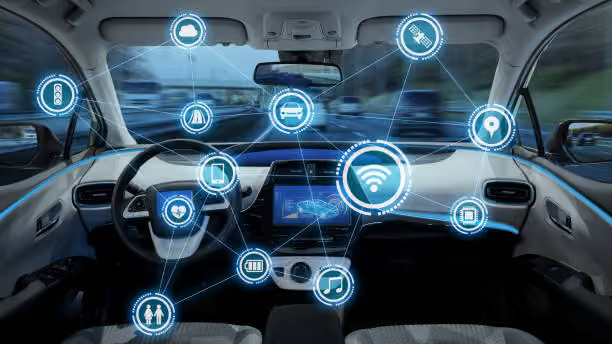
Safe-driving applications gather information through smartphone sensors or vehicle-mounted devices. Contemporary apps monitor comprehensive metrics including speed patterns, aggressive acceleration, hard braking, and phone usage tracking. Advanced applications detect when drivers physically handle phones using accelerometer and gyroscope data.
IIHS research uses anonymised telematics data with privacy protections. Information from multiple drivers is aggregated before sharing with researchers, making individual identification impossible.
Current limitations include recent data collection introduction and voluntary participation, meaning researchers cannot analyse long-term trends effectively, and data likely overrepresents cautious drivers.
The temporal and geographic precision represents a major advancement. Researchers can focus on specific road segments or intersections, extracting data from targeted locations before and after interventions like new pedestrian crossings.

Driver distraction research benefits immediately. An early IIHS study revealed drivers used phones during more than 3% of trip time—1% for handheld calls, 2% for texting or device manipulation. This measurement approach was entirely novel compared to roadside observations at single moments and locations.
Future IIHS research will assess Arizona's 2019 law prohibiting wireless device handling while driving. Additional studies will measure mobile phone use underreporting in police crash reports and investigate relationships between phone use and speeding.
Telematics enables behaviour modification through personalised feedback. Recent AAA Foundation research showed feedback and financial incentives reduced speeding by 13%, hard braking by 21%, and rapid acceleration by 25%.
Community planning could benefit from identifying locations where dangerous driving behaviours are most prevalent, enabling proactive infrastructure decisions before crash rates increase.
Telematics technology won't replace existing safety research tools but creates new analytical approaches for addressing longstanding problems and developing innovative solutions. This expanded capability provides additional motivation for drivers considering safe-driving applications.