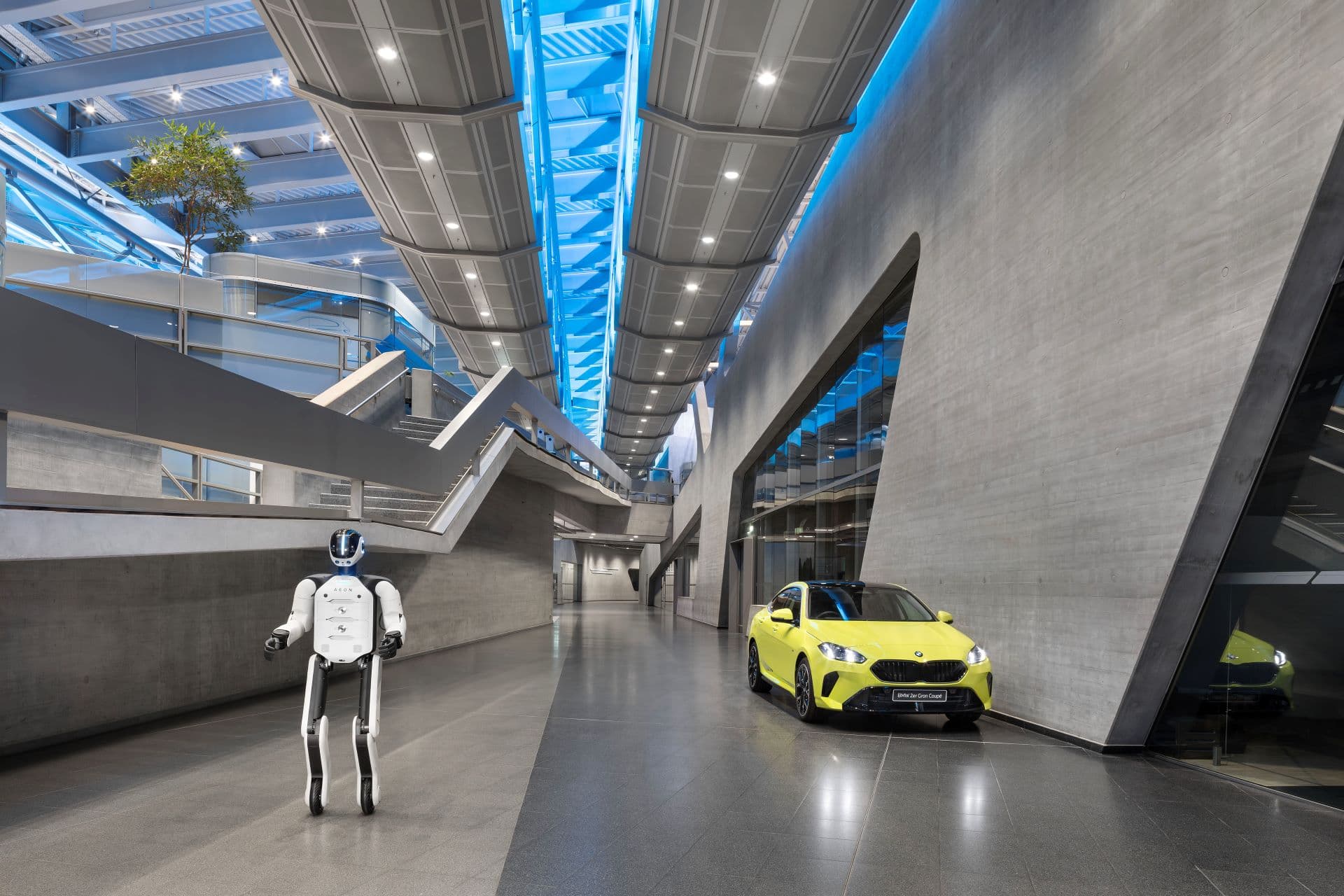
The BMW Group is strengthening its position as a leader in intelligent manufacturing with the launch of a new pilot project using humanoid robots at its Leipzig plant. Building on earlier successes in the United States, the company is now bringing its Physical AI strategy—where digital AI interacts with physical robotics—into European production for the first time.
The project aims to integrate humanoid robots directly into series production, as well as into battery and component manufacturing. BMW sees this as a crucial step in enhancing efficiency and improving workplace ergonomics. By assigning repetitive, physically demanding, or safety-critical tasks to robots, employees can focus on higher-value work.
At the centre of this initiative is AEON, a humanoid robot developed by BMW’s long-standing technology partner Hexagon. After theoretical evaluations and laboratory testing, AEON underwent initial trials in Leipzig at the end of 2025. Further testing scheduled for 2026 will prepare the robot for a full pilot phase in the summer. AEON’s modular, human-like form allows multiple tool attachments and dynamic movement, making it well suited for high-voltage battery assembly and component production.
This European rollout follows a landmark 2025 project at BMW Group Plant Spartanburg in the United States. There, the robot Figure 02 successfully supported the production of BMW X3 vehicles, completing more than 1,250 operating hours and handling over 90,000 components. Crucially, the transition from laboratory training to real-world shift work was faster than expected, demonstrating the readiness of Physical AI for industrial environments.
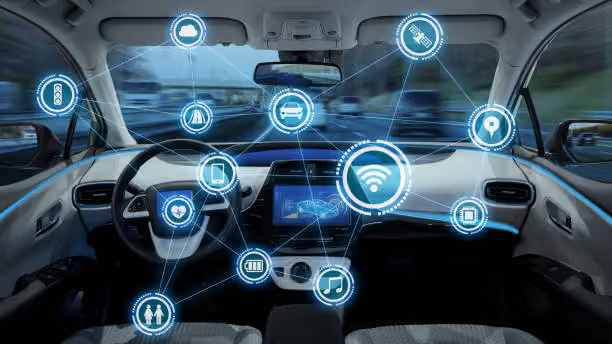
Underpinning these advancements is BMW’s unified IT and data platform, which eliminates siloed information and enables AI systems to operate autonomously across production. This provides the foundation for digital agents capable of decision-making, learning, and supporting increasingly complex tasks.
To accelerate development, BMW has established a new Center of Competence for Physical AI in Production. This hub consolidates expertise, standardises evaluation methods, and ensures that successful applications can be scaled across the global production network.
As BMW prepares for further testing—including potential future use of next-generation humanoid robots—the company continues to position digitalisation and AI at the core of its future manufacturing strategy.