Mercedes-Benz has unveiled its Tomorrow XX programme, signalling a decisive shift in how the company plans to reduce the environmental burden of its vehicles from inception to recycling.
Announced in December 2025, the initiative takes the manufacturer’s well-known “XX” innovation efforts far beyond experimental show cars and firmly embeds sustainability into the brand’s long-term engineering strategy.
Unlike a conventional model launch, Tomorrow XX is best understood as a guiding philosophy — a system-wide blueprint for designing, producing and retiring vehicles with far lower carbon and resource costs. The ambition is to rethink each stage of the automotive process so that waste is minimised and materials retain value for as long as possible.
A core pillar of the programme is the pursuit of smarter, more circular material use. Working jointly with suppliers, research institutions and emerging tech companies, Mercedes-Benz has identified over forty new components and material solutions with improved environmental performance. While these range from near-production innovations to early-stage concepts, collectively they illustrate how sustainability can be woven into engineering without compromising the brand’s standards.
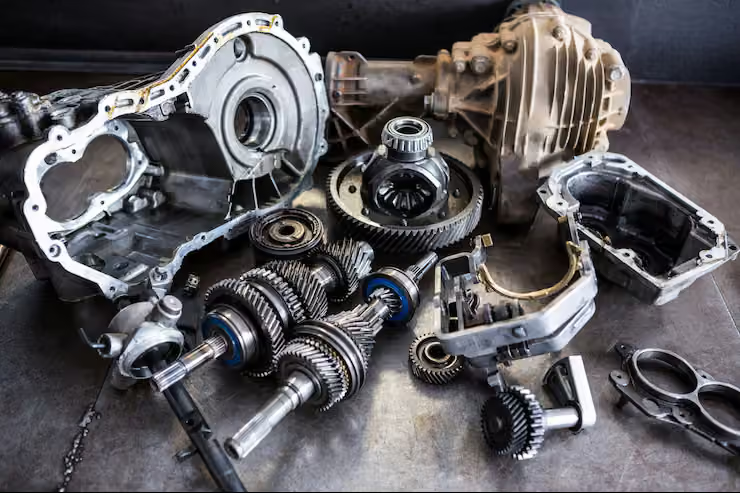
Circularity plays a central role. Components are being redesigned so that they can be dismantled easily and reassembled or recycled without damage — a significant departure from legacy designs that rely heavily on bonding or complex construction. One example is a newly developed headlamp assembly that uses screw-fastened parts instead of adhesives, making individual elements straightforward to replace or reuse and improving recyclability at end-of-life.
The company is also enhancing its shift towards mono-materials, particularly single-type plastics that simplify recycling. A PET-based mono-sandwich structure used in interior parts has been shown to cut emissions dramatically compared with traditional composites, underscoring the value of a circular-first mindset.
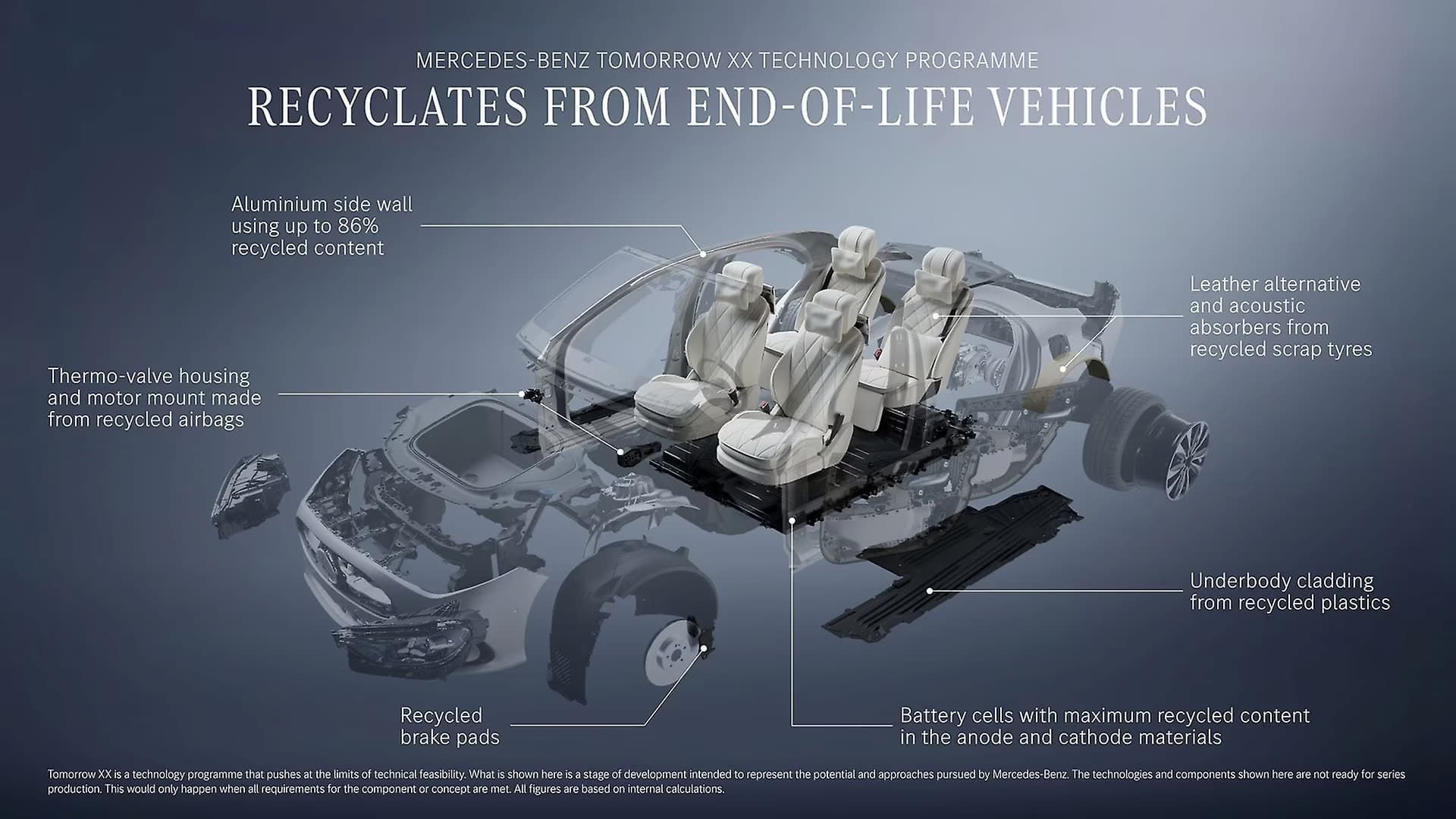
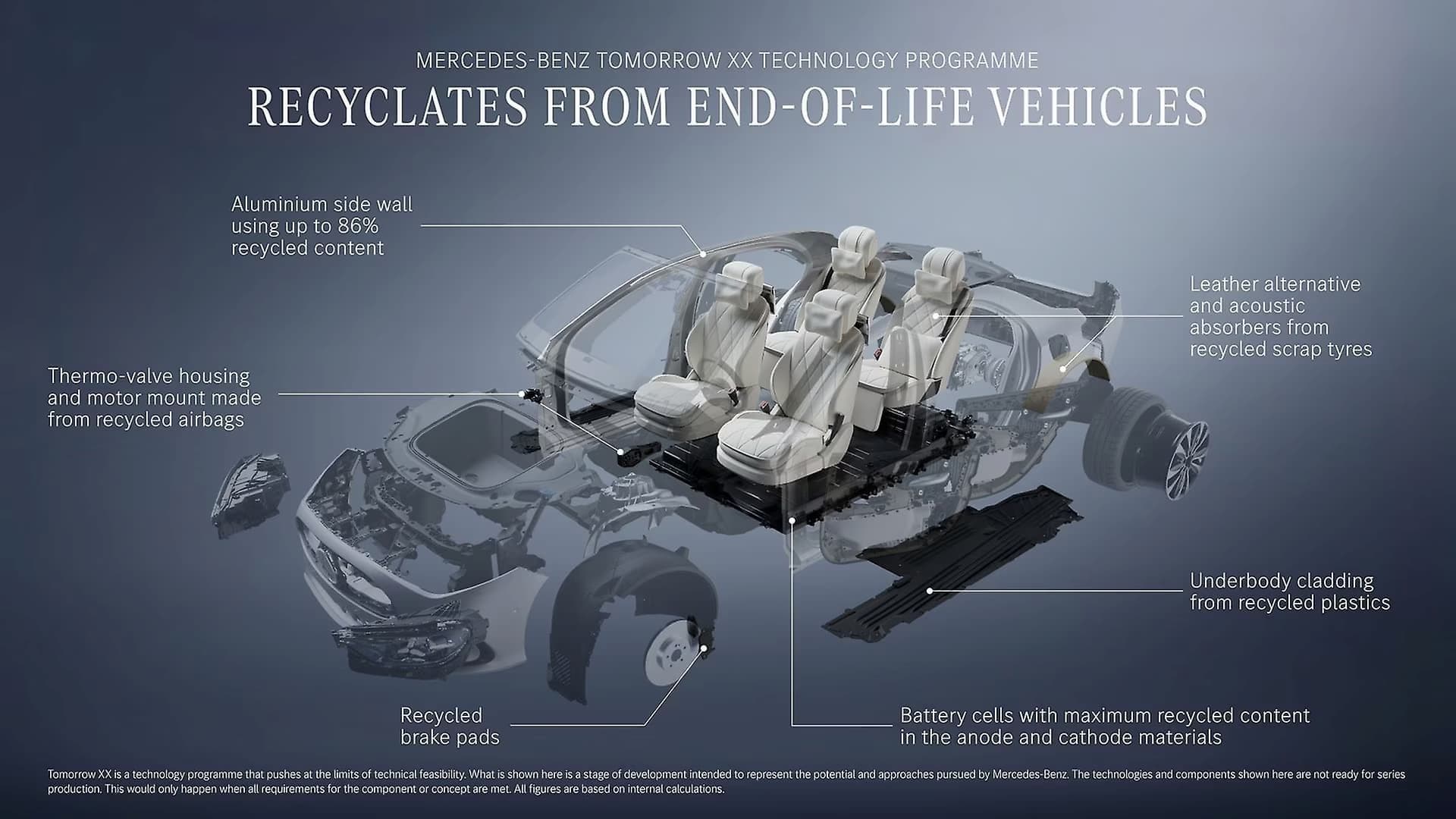
Metals, often among the most carbon-intensive materials in vehicle production, are also under the spotlight. Mercedes-Benz is expanding its use of secondary aluminium and steel and investigating more efficient recycling loops for plastics and brake components. In certain cases, these developments have the potential to reduce emissions associated with individual parts by as much as 85 per cent.
More broadly, Tomorrow XX marks an evolution in how the company approaches sustainability. No longer positioned as an add-on or a marketing theme, it is now treated as a principle that must be integrated into every design choice, manufacturing process and dismantling procedure. It aims to nudge the brand closer to a genuinely circular model — one that continually reuses resources rather than discarding them.
Although many Tomorrow XX concepts remain in development and will take time to enter full-scale production, the overarching message is clear: Mercedes-Benz intends environmental stewardship to become a defining quality of its future vehicles. The programme sets a new benchmark for the company and places it firmly among the automotive leaders reshaping mobility for a lower-impact future.