State planning shapes an industry
China’s automotive industry has been central to national industrial policy for decades. According to Michael Enright, Professor in Global Business at Northeastern University in the United States, the sector has enjoyed sustained state backing since the early years of China’s economic opening.
His research, published by the Hinrich Foundation, explains how the car industry became one of the first sectors to receive focused national development planning.
https://www.hinrichfoundation.com/research/article/fdi/china-auto-policies-playing-the-long-game
“It was the subject of China’s first specific national development plan after its economic opening in the 1980s and continues to receive close attention and protection from Beijing,” he writes.
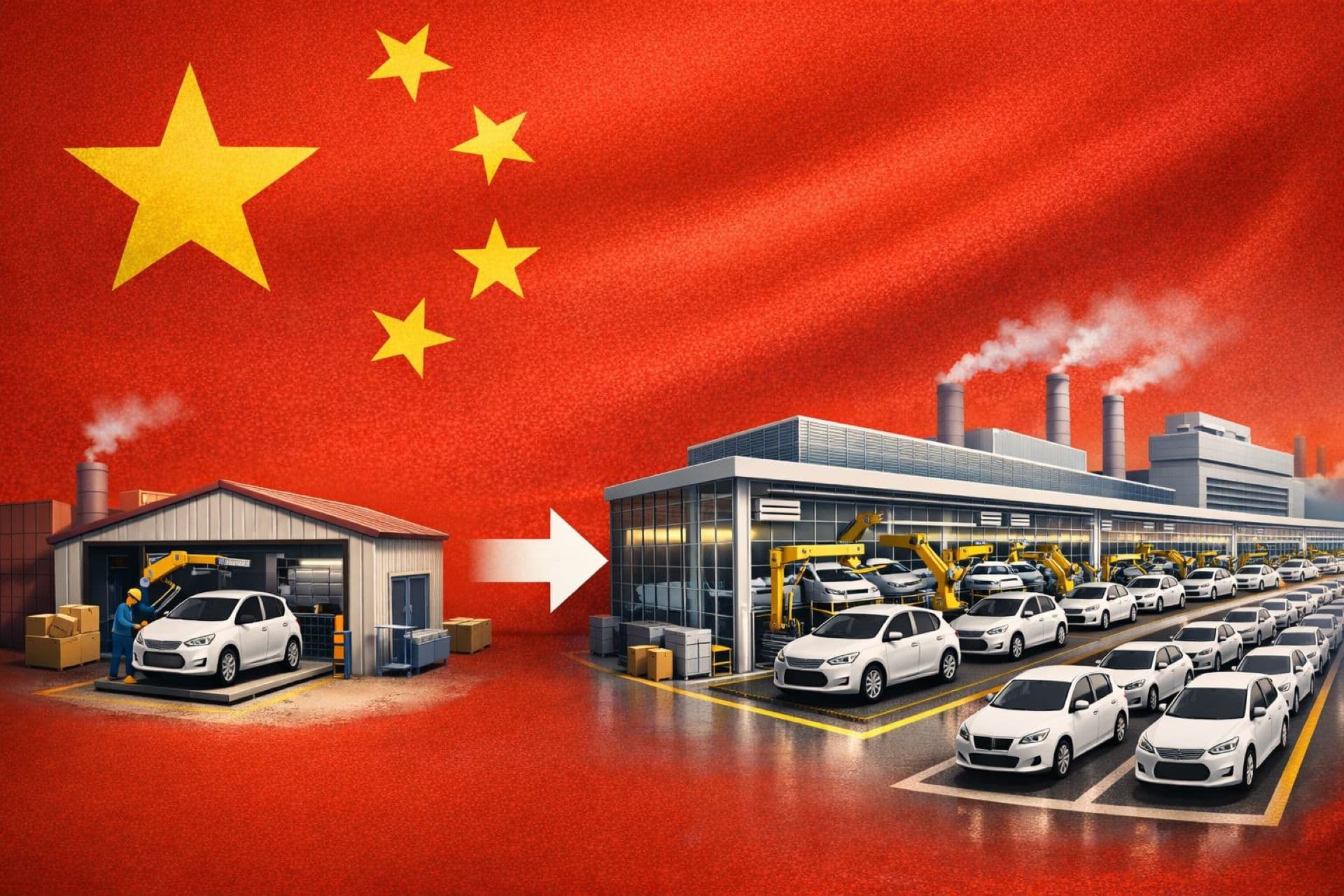
From the beginning, China’s objective was not merely to assemble vehicles but to cultivate domestic manufacturers capable of competing at home and abroad. This long term ambition shaped the policies that followed, from state ownership to the careful management of foreign involvement.
Laying the industrial foundations
Government ownership has been fundamental since the 1950s. Major manufacturers such as FAW, Dongfeng, SAIC, GAC and BAIC were created through state initiatives or taken over by local authorities. These firms remain dominant players in China’s automotive landscape today.
Foreign technology was deliberately drawn into the system. During the 1980s and 1990s, international carmakers were permitted to enter China only through tightly regulated joint ventures. Foreign companies were limited to minority ownership and were instructed where to locate production. They were also required to transfer technology, train Chinese employees and increase local sourcing.
By 1991, an internal assessment suggested that foreign involvement had accelerated China’s automotive development by three decades. This early emphasis on learning from global leaders helped lay the groundwork for rapid growth.
Protection, consolidation and scale
Tariffs and localisation rules shielded domestic producers. In the 1980s, import duties on fully built vehicles exceeded 200 percent. Although China joined the World Trade Organisation in 2001, restrictions on market access and ownership remained significant.
During the 1990s and 2000s, policy makers sought to consolidate the industry into a limited number of large national champions. While state owned enterprises were prioritised, private firms such as Geely, Great Wall and BYD also expanded rapidly outside official plans.
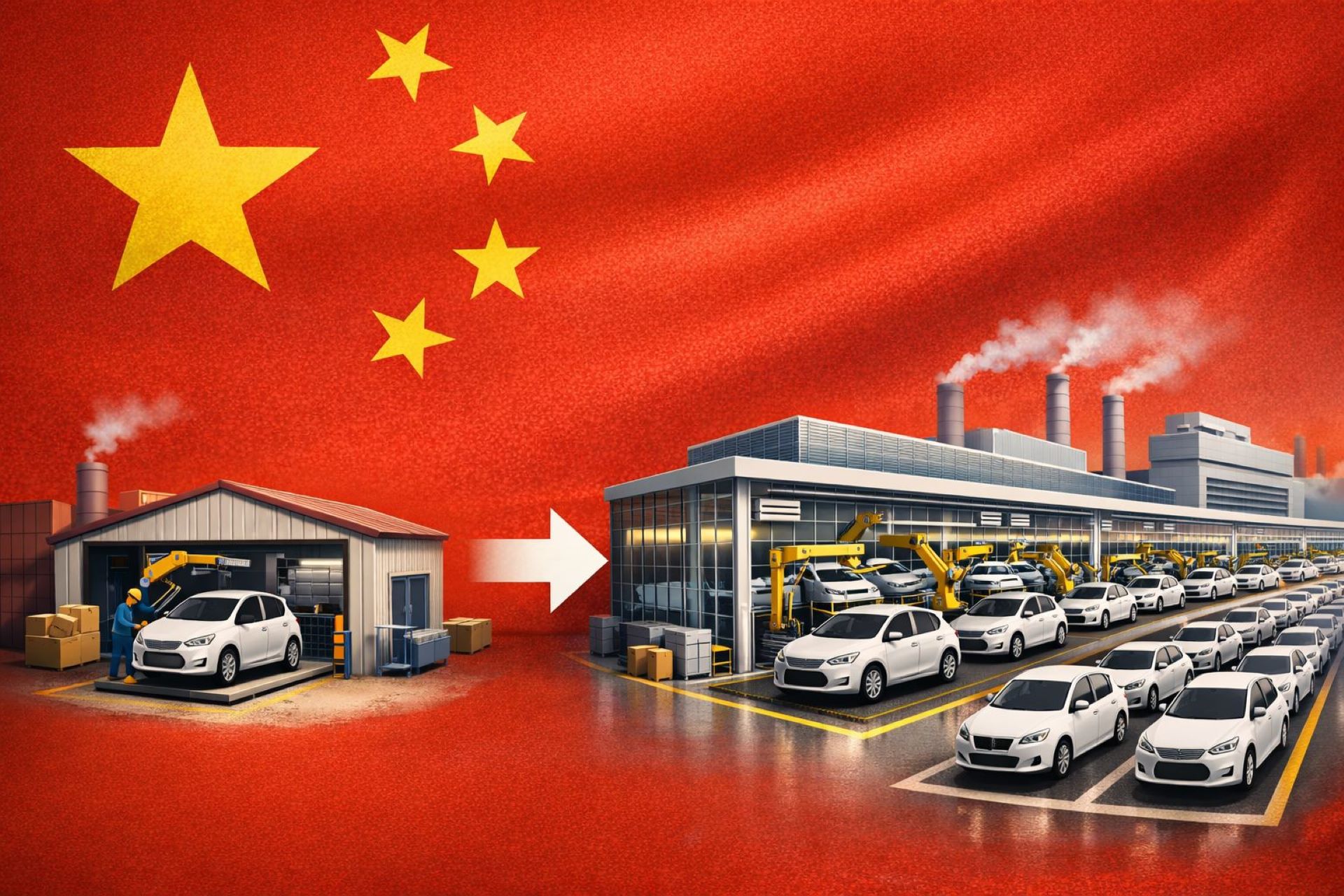
Production growth was dramatic. Passenger car output rose from 5,200 units in 1985 to more than 31 million in 2024. By that point, China accounted for around 32 percent of global vehicle production, exceeding the combined output of the United States, Japan, India and South Korea.
The electric vehicle turning point
Despite its scale, China struggled for years to build globally competitive domestic brands. As recently as 2019, analysts argued that many state owned manufacturers still lacked strong brand identities.
Electric mobility changed this trajectory. Listed as a priority in the 10th Five Year Plan in 2001, electric vehicles became the sector where China could leapfrog established players. Wan Gang, a former Volkswagen Audi engineer who later became Minister of Science and Technology, argued that China could not catch up in internal combustion engines but could lead in electric vehicles.
Subsidies, infrastructure investment and protection accelerated the transition. Tesla was permitted to establish the first fully foreign owned car plant in China in 2018, but only after agreeing to integrate into China’s electric vehicle supply chain. By 2022, China accounted for 56 percent of Tesla’s global output.
Between 2009 and 2023, central government subsidies for electric vehicles reached an estimated US$231 billion. Buyer subsidies once averaged R225 302 or US$14 000 per vehicle. Local authorities added further incentives, while emissions credit schemes forced manufacturers to invest in electric technologies.
Electric vehicle sales rose from 3.2 percent of the market in 2017 to 41 percent in 2024, when China accounted for nearly 70 percent of global electric vehicle sales. BYD led the domestic market with 34 percent share, followed by Geely, SAIC, Tesla and Changan.
Foreign brands lose ground
As electric vehicles surged, foreign brands saw their share of the Chinese market fall sharply from 64 percent in 2020 to 35 percent in 2024. German, Japanese and United States manufacturers all experienced double digit declines. Volkswagen and General Motors, once dominant, were particularly affected, having underestimated Chinese innovation and the pace of electric vehicle adoption.
Exports and policy lessons
China’s rising electric vehicle capacity, combined with weakening demand for petrol and diesel vehicles at home, has driven a surge in exports. In 2024, China exported 5.9 million vehicles, with Chery, SAIC, Geely, Great Wall and BYD among the leading exporters.
Some countries fear that China’s excess capacity will allow it to undercut competitors and dominate global markets. Enright concludes that China’s experience highlights the impact of long term policy commitment, technological change and state resources.
“Though China’s auto industry has not developed as China’s leaders planned, it shows that long term policy commitment, technological change, massive state resources, and the influence of the Chinese Communist Party state have an enormous impact,” he writes.
For foreign firms, the challenge is how to regain relevance in China while protecting home markets. For governments, the question is how to respond to rising Chinese exports, often through tariffs and other protective measures.
•About the Hinrich Foundation
The Hinrich Foundation is an Asia-based philanthropic organisation dedicated to advancing sustainable global trade. It produces original research and education programmes to build understanding and leadership in global trade. It operates as a registered charity in Singapore and a 501(c)(3) corporation in the US.
•Explore more at the Hinrich Foundation website: https://www.hinrichfoundation.com/